

All rights reserved by the author | 8 November 2025
There are rivers that move through land, and there are rivers that move through time. The Nile belongs to the second kind. From the granite strength of the Aswan High Dam, built with Russian collaboration in the 1960s, this ancient river continues its long conversation with Egypt. It carries not only water but whispers — of pharaohs and poets, of temples and revolutions, of all that has been dreamt and endured.
A modern cruise begins from Aswan, where the dam rises like a curtain between eras. From there, the ships glide north, slow and deliberate, tracing the same path once followed by papyrus boats and royal barges. The deck becomes a moving balcony to history. Every few hours, the landscape changes — palm groves give way to stretches of golden desert, minarets shimmer in the distance, and the river bends toward stories waiting to be retold.
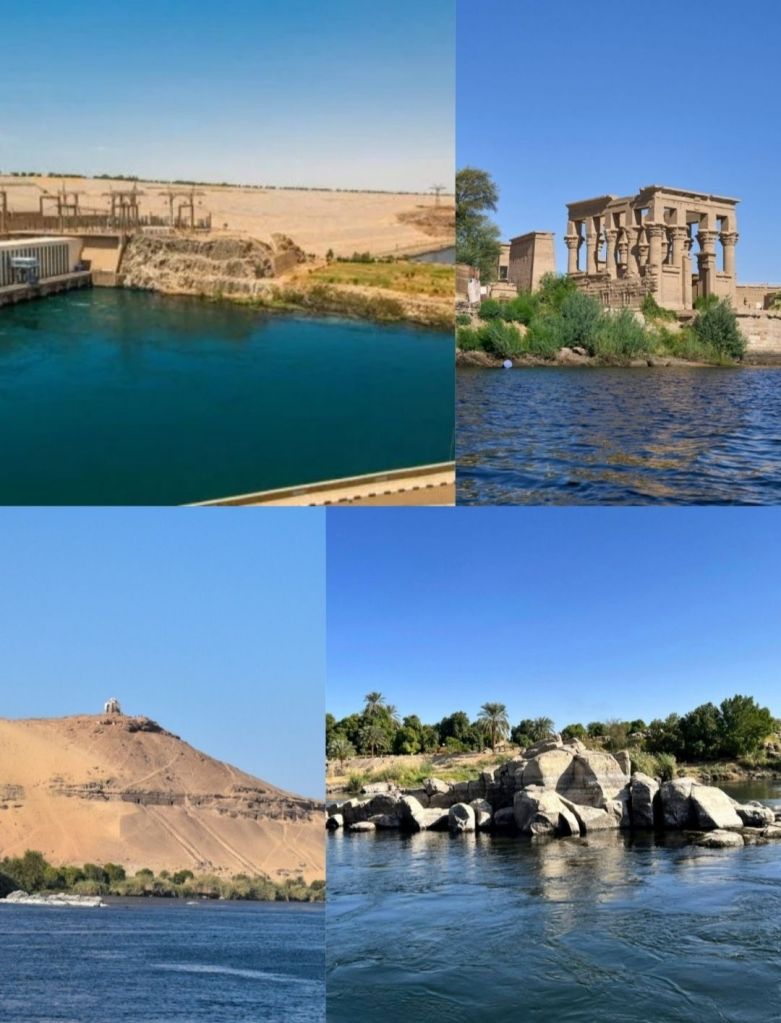
The ship halts at Kom Ombo, where a temple dedicated to two gods — Sobek, the crocodile, and Horus, the falcon — watches over the water with timeless patience. Further ahead lies Edfu, one of the best-preserved temples of Egypt, its massive columns casting long shadows across the noon light. By evening, the cruise reaches Luxor, where the Valley of Kings hides the resting places of pharaohs beneath a quiet sky.
Between these stops, one unforgettable moment awaits every traveler — the ship enters a narrow waterway where the river’s level suddenly drops. Engineers control massive gates that lower the vessel from one elevation to another, letting it pass safely between dams. As the walls rise on both sides and water slowly recedes, passengers often stand in silence, feeling time itself adjusting its rhythm.
When the ship finally emerges, the Nile seems wider, calmer — as if it too had paused to remember. The sun dips low, brushing the surface with liquid gold. Somewhere beyond the bend, Cairo waits. And in that glowing hour, one understands why Egypt’s heart still beats in sync with its river — because the Nile doesn’t just flow through land; it flows through memory.
Rajat Chandra Sarmah
Guwahati, Assam, India
Instagram @rajatchandrasarmah5
YouTube @conversewithasmile
 musingofrajat.wordpress.com