Part Three : The Haunted Library of Manikpur


As Santa stood before the grand chandelier with Dipen, the oppressive darkness seemed to thicken, and the silence was shattered by an eerie, spine-chilling whisper that slithered through the room like a phantom’s hiss. Her heart raced, and she could feel the unseen malevolence closing in on them.

With trembling hands, Santa began to recite the incantations again from Nathani’s writings. Her voice wavered, and the words seemed to hang in the air like a spectral chant. The screaming inside the room intensified and Santa started shouting Nathani’s incantations with her voice trembling with fear.  The room responded with a subtle, resonating hum that seemed to vibrate from the very walls. Dipen could not understand what going on and was mum witnessing the going on and the actions of Santa.

The chandelier above her swayed again with menacing vigour, casting grotesque, ever-shifting shadows that danced with sinister glee. Its chains rattled in a macabre melody, clinking like chains in a haunted dungeon, as if it were celebrating the unfolding horrors.

Suddenly, a burst of unnatural, ghostly laughter pierced the room, echoing and reverberating as if it were the laughter of tormented souls. It was a sound that clawed at Santa’s sanity, each chilling laugh more agonizing than the last.

The apparition from her previous visit materialized before her, its hollow eyes filled with malevolence. It spoke in a chilling, echoing voice that seemed to come from every direction at once, its words seeping into her very bones. The name “Meena” resounded with an eerie, unnatural resonance.

Meena revealed that the library was a gateway to a dimension of torment and suffering, and Nathani had unwittingly unleashed its horrors into the town. The malevolent spirits, once imprisoned, had been set free, and they hungered for revenge against the living.

The room’s temperature plummeted as Meena recounted the torment that awaited Manikpur, her words a mournful chorus that filled the air with anguish. Santa’s breath formed frosty plumes as the very atmosphere seemed to freeze in response to the malevolence that had been unleashed. Suddenly Meena cried loudly and white skull was standing in front of them laughing loudly. Santa fainted.  Dipen lifted her and took her out of the library. Suddenly everything got normal. after spraying water on her face, Santa regains her senses.

Santa realized that she had unwittingly become a part of the curse’s unfolding, her quest for knowledge transformed into a descent into an abyss of horror. The evil presence had ensnared her, and her determination to confront the unknown had led her to the precipice of a nightmarish ordeal.

With newfound determination, Santa knew that she had to find a way to reverse the rituals and banish the evil spirits back to the abyss from which they had emerged. The library had become a battleground between the forces of darkness and the flickering flame of her Torch. She was determined to confront the horrors that awaited her in the shadows.

The encounter with Meena had etched a horrifying picture of dread in her mind, a visual and auditory nightmare that would haunt her for eternity. She was no longer a mere seeker of knowledge; she was a survivor in a supernatural battleground, and her journey was far from over.

In the following days, Santa delved even deeper into the cryptic history of the Manikpur Library. She became consumed by her research, poring over ancient texts, crumbling manuscripts, and forgotten scrolls in her state library. Each piece of the puzzle she unearthed only deepened the chilling narrative of the library’s dark past.

As she rummaged through the dusty archives, her fingers brushed against a fragile, leather-bound book that seemed almost to beckon her. She gingerly pulled it from the shelf, and as she opened its pages, a sense of dread settled over her like a shroud. The book was filled with handwritten notes becoming brown, sketches of otherworldly symbols, and accounts of the malevolent presence that had long haunted the Manikpur library.

The pages revealed the stories of those who had encountered the evil spirits over the centuries. Each account was a testament to the terror that had festered within the library’s walls. Santa felt as if the very souls of those who had penned these entries were reaching out from the past to share their torment.

But it was one particular entry that sent shivers down her spine. It was a detailed account from a librarian who had lived in the 19th century, much like Santa herself. The librarian described how they had unwittingly stumbled upon Nathani’s writings, just as she had, and had been drawn into the malevolent rituals. The entry spoke of a nightmarish descent into madness and the terror of the spirits that had tormented the librarian’s very soul.

The librarian’s writing grew increasingly frantic and disjointed, as if the horrors they had experienced defied coherent expression. They had made a desperate attempt to reverse the rituals, but it had only unleashed greater malevolence. The librarian’s final words were a haunting plea for someone in the future to undo the curse they had unwittingly perpetuated.

Santa couldn’t help but feel an eerie connection to her predecessor, as if the librarian’s tormented spirit still lingered within the library, waiting for someone to heed their warning.

The more she uncovered, the more the library seemed to respond to her quest for knowledge. Mysterious symbols etched themselves onto the walls, glowing with an otherworldly light that illuminated the chamber with an eerie, spectral glow. It was as if the very architecture of the library held secrets that it yearned to share.

As Santa deciphered the symbols, they revealed a disturbing connection between Nathani, the occultist from the 18th century, and a mysterious entity known as the “Soul Eater.” The Soul Eater was said to be an ancient force of malevolence that had been bound to the library by Nathani’s rituals, its hunger for the souls of the living insatiable.

Santa’s investigations also led her to an underground chamber that had long been forgotten. Its entrance, concealed beneath a crumbling staircase, opened into a labyrinthine network of tunnels that stretched beneath the library. The tunnels were adorned with macabre carvings that told a ghastly tale of the rituals conducted by Nathani and the horrors he had unleashed.

With each new revelation, Santa felt herself drawn deeper into a web of terror and intrigue. The library itself seemed to come alive with each discovery as if it were guiding her through a nightmarish odyssey of its own making.

The more she uncovered, the more the evil presence within the library seemed to intensify its assault. The atmosphere grew thick with an otherworldly tension, and shadows whispered malevolent secrets. As Santa ventured deeper into the tunnels, she could sense the malevolent spirits drawing closer, their presence a suffocating weight that threatened to consume her.

Santa knew that she was on the precipice of a revelation that would shake the very foundations of her reality. She had embarked on a journey into the darkest recesses of the library’s past, and the horrors that awaited her were beyond anything she could have imagined.

As she descended deeper into the underground chamber, the walls seemed to close in around her, and the air grew colder with each step. The symbols etched into the stone pulsed with an unnatural energy, casting grotesque shadows that danced with eerie, spectral forms.

Santa’s determination to unravel the past was now wrapped with a sense of dread that threatened to overwhelm her. The library, with all its malevolent secrets, had become a living nightmare from which there might be no escape. The horrors of the past were awakening, and they hungered for the truth that Santa sought to reveal.

Every detail she uncovered added another layer of mystery and horror, and with each revelation, the curiosity of the readers deepened. Santa’s journey into the heart of darkness was far from over, and the library’s secrets were poised to unleash a nightmare that would test her courage and wits to their limits.

PART 2: The haunted Library of Manikpur


Santa returned to her state library, her heart still racing from the haunting encounter with the ghostly figure in the Manikpur Library. She knew that she had to uncover the dark secrets hidden within those forsaken walls, not just for her own curiosity but for the sake of the entire town.

Over the next few days, Sarah immersed herself in extensive research about the Manikpur Library’s history. She pored over dusty archives, old newspapers, and obscure books. As she delved deeper into the past, a chilling narrative began to take shape.

The library’s history was intertwined with the mysterious disappearance of a renowned occultist and writer named Nathani, who had visited Manikpur in the late 18th century. Nathani had come to the town in search of forbidden knowledge, and he believed that the library held ancient tomes and forbidden rituals that would unlock unimaginable power.

As Santa read through Nathani’s writings, she uncovered a detailed account of the rituals he had conducted within the library’s confines. These rituals were far more sinister and dangerous than she could have ever imagined. They involved summoning evil spirits and invoking curses that could manipulate time and reality.

With trembling hands, Santa transcribed the incantations and symbols from Nathani’s writings. She knew that to confront the malevolent presence in the library, she needed to understand the rituals that had unleashed it.

One fateful evening, Santa returned to the Manikpur Library, on a moonless night clutching her transcriptions and the torch that had become her only source of comfort. The library was silent, and the oppressive darkness seemed to close in on her as she made her way to the very room where she had encountered the ghostly figure.

As she stood before the grand chandelier, she began to recite the incantations from Nathani’s writings. Her voice trembled, and the air grew heavy with an otherworldly tension. The chandelier above her swayed menacingly, casting ever more grotesque and contorted shadows.

Suddenly, a burst of unnatural, ghostly laughter filled the room. The apparition from her previous visit appeared, its hollow eyes filled with malevolence. It spoke in a chilling, echoing voice, revealing its name as “Meena” and its connection to the rituals of Nathani.

Meena revealed that the library was a gateway to a dimension of torment and suffering, and Nathani had unwittingly unleashed its horrors into the town. The malevolent spirits, once imprisoned, had been set free, and they hungered for revenge against the living.

The room’s temperature plummeted as Meena recounted the torment that awaited Manikpur unless the rituals were reversed. Soon Meena vanished. Suddenly the lights were glowing and the breeze outside stopped. Everything become normal. Santa realized that she had unwittingly become a part of the curse’s unfolding, and her quest for knowledge had unleashed a horror beyond her comprehension.

With newfound determination, Santa knew that she had to find a way to reverse the rituals and banish the malevolent spirits back to the abyss from which they had emerged. The library had become a battleground between the forces of darkness and the flickering flame of her Torch, and she was determined to confront the horrors that awaited her in the shadows.

Santa leaves the place with a determination to find out the story of Meena

Santa had been conducting her research on the Manikpur Library in isolation, keeping her findings hidden from the prying eyes of the townspeople. At the same time, Dipen, the self-proclaimed ghost hunter, had conducted his own investigations with a team of paranormal enthusiasts. Both were unaware of each other’s endeavours.

One moonless night, townsfolk observed the same phenomena of a sudden breeze followed by the screaming of a woman, a  sense of dread hung in the air. An ancient malevolence had awakened, and it had set its sights on those who dared to unravel its dark mysteries. The townsfolk gathered in scare.

 As the townsfolk gathered in hushed whispers to discuss the haunting of the library, Dipen and his team decided to enter the forsaken building. Armed with an array of ghost-hunting equipment and an assortment of protective charms, they ventured into the darkened library on that moonless night, hoping to capture evidence of the supernatural. With trepidation, Dipen and his team decided to enter the forsaken Manikpur Library. Their footsteps echoed in the eerie silence as they ventured into the pitch-black void. The oppressive darkness seemed to claw at them, and the air was saturated with a sinister chill that crept beneath their skin.

Meanwhile, Santa, determined to confront the evil presence within the library, had visited once more with her transcriptions and the flickering Torch on the same moonless night. She was in the midst of reciting Nathani’s incantations, seeking to understand the rituals that had unleashed the horror, when she was startled by the distant sounds of approaching footsteps.

The air grew heavy with an ominous tension, and the room seemed to resonate with a dark energy. Santa extinguished her Torch and retreated into the shadows, her heart pounding. She watched as Dipen and his team entered the room, their flashlights sweeping the space in search of any abnormal happenings.

The investigators from both parties, drawn by the malevolent presence, began to experience the unexplained phenomena in tandem. Ghostly whispers filled the room, and the oppressive darkness seemed to close in around them. They felt unseen hands tugging at their clothing, and an icy chill hung in the air. The chandelier above them began to sway menacingly, casting grotesque, ever-shifting shadows.

As their equipment malfunctioned and their attempts to communicate with the spirits were met with chilling responses, panic set in with Dipen. It was clear that the malevolent presence within the library had singled out the investigators and was determined to make them face the horrifying truth that had remained concealed for centuries.

In the midst of this terrifying encounter, Santa and Dipen make eye contact in the flickering light without knowing each other and feeling the other as the evil spirit in disguise. Their mutual fear keeps them doubting and an err of fear runs over their spine. Santa calls Dipen, are you human?  Dipen waited and observed Santa deeply till he was sure that Santa was a normal human being, he replied and soon found they were on the same mission to find out the truth of the supernatural forces at play, bringing them together in an unspoken alliance. In that horrifying moment, they knew that they had to join forces to confront the malevolent spirits that dwelled within the forsaken library and uncover the dark secrets of the past.

Together, as the evil presence intensified its assault, Santa and Dipen formed an unlikely duo, their separate investigations converging into a shared mission to confront the supernatural horrors that lurked within the library’s cursed walls. The chilling revelation that awaited them would challenge their courage, wits, and the very fabric of their reality.

The Haunted Library at Manikpur

(ONE)

In the quiet town of Manikpur, nestled among the hills and surrounded by an ancient forest and a small population. It is a lovely peaceful township away from the busy city life. But suddenly, the People of the town on every moonless night, witness a peculiar phenomenon of a heavy wind surrounding the forest and the screaming of a woman followed by a power failure in the town area. It was happening every moonless night. Some of the residents of the town reported having seen a young girl in white attire running towards the forest during the wind and vanishing to oblivion. No one believed at first, but when it started happening in every moonless night people got scared. The entire town was awoken by blood-curdling screams that seemed to emanate from the depths of the forest.

The townsfolk gathered in panic, whispering tales of an evil presence in the woods. They described glimpses of shadowy figures and unnatural lights flickering among the trees. Fearful for their safety, the townspeople decided to form a young group of people volunteering to uncover the truth behind these sinister events.

The young team, led by the town’s self-proclaimed ghost hunter, Dipen, gathered on the moonless night in the outskirts of the forest, their flashlights piercing the oppressive darkness.  They ventured deeper into the woods. Soon the wind started and after some time, the screaming of a girl made the scene frightening.  They heard the screaming and the eerie cries grew louder and more unsettling. The heavy wind started coming and twisted the branches seeming to reach out for them, and the cold night air hung heavy with an otherworldly aura. The light went off suddenly. Some of the team had seen a young girl in white attire running to the forest. The team followed the girl and suddenly she vanished, they stumbled upon an ancient, overgrown path that led them to a clearing where an ominous, dilapidated structure stood. It was the backside of the once-busy Town Library, its grand facade now a crumbling, ghostly silhouette against the night. An icy wind swept through the clearing, and a faint, mournful tune could be heard, like a piano playing in a long-forgotten chamber.

As they cautiously approached the library, its windows emitted an eerie, ethereal glow, and strange symbols flickered on its weathered walls. The doors swung open with an eerie creak, inviting them inside. The young team, though terrified and intrigued, entered the library, unaware that they were about to uncover a centuries-old curse that would lead them down a path of chilling revelations and unimaginable horrors.

As the team entered the forsaken library, an eerie silence enveloped them. Their flashlights cast quivering beams of light that revealed a frozen scene. Dusty, cobweb-covered bookshelves lined the walls, and ancient tomes lay scattered across the floor as if discarded in a hurry. The air was suffused with the pungent scent of decay.

Just as the explorer began to question the wisdom of entering this supposed-to-be haunted place, a sudden gust of icy wind swept through the library, extinguishing their flashlights in a chilling, collective gasp. Darkness closed in around them, and the nightmarish symphony of haunting events began.

From the shadows, disembodied whispers and ghostly laughter echoed through the room, making the investigators shiver with dread. Unseen hands tugged at their clothing as if trying to pull them deeper into the library’s sinister embrace. Dipen, the self-proclaimed ghost hunter, felt a cold hand clutch his shoulder with a vice-like grip, causing him to recoil in terror.

The explorers fumbled to relight their flashlights, their trembling hands struggling to find the switches. With each flicker of the lights, they caught unsettling glimpses of the library’s ghostly inhabitants. Pale, spectral faces appeared in the darkness, their eyes hollow and filled with sorrow.

Books floated off the shelves, their pages flipping wildly as if guided by an invisible force. The explorers watched in horror as words and images from the books twisted and contorted, telling tales of ancient curses and forgotten sorrows. It was as if the library itself was revealing its tragic history through these malevolent manifestations.

The grand chandelier hanging from the ceiling suddenly swung with unnatural vigour, casting grotesque, dancing shadows on the walls. The investigators realized that they were not alone in this haunted library; a presence, ancient and vengeful, lurked among them, and it was determined to make them face the chilling truth that had remained concealed for far too long.

Amid these horrifying phenomena, the investigators exchanged fearful glances and understood that they had stepped into a nightmare from which there might be no escape. The library had come alive with malevolence, and they were now entangled in a web of terror that would challenge their courage and wits like never before. They leave the place as fast as possible without looking back in the fear of someone following them.

Santa, the young and inquisitive librarian of the state library, had been following the unsettling reports about the haunting of the old library with a mix of fascination and trepidation. She had always been drawn to mysteries and the unexplained, and the library’s reputation as a haunted place only fueled her curiosity. Further people have stopped visiting the library for a long time because of all the things that were unfolding.

One gloomy afternoon, as Santa sat at her desk in the quiet state library, the whispered tales of the eerie occurrences at the Manikpur Library weighed heavily on her mind. She couldn’t resist the urge to investigate the place herself, to separate fact from fiction.

Armed with her determination and an old torch, Santa entered the forsaken library on a stormy night. The rain lashed against the windows, casting distorted, dancing shadows on the walls. The faint, distant rumble of thunder added an ominous soundtrack to her journey. The screaming was now audible and piercing.

she ventured deeper into the darkened library, the air grew thicker, and an oppressive sense of dread washed over her. It was as if the very walls of the building held secrets that yearned to be uncovered. The flickering Torch cast eerie, ever-changing shapes on the walls, making them appear to come alive with spectral images. Suddenly, a blood-curdling scream echoed through the library. Santa’s heart pounded in her chest as she followed the sound, her Torch’s light trembling with each step. She arrived at the main reading room and saw an apparition, a pale figure in a tattered, white gown, standing before the grand chandelier. Its hollow eyes fixed on her with an intensity that sent shivers down her spine. Before her eyes, the chandelier above began to sway with menacing vigour, casting grotesque shadows on the walls. Whispers of sorrow filled the room as if a chorus of lost souls was weeping in the dark.

Rajat Chandra Sarmah

Guwahati 2/11/2023

To be continued

Durga Puja – A faith and festivity

 The celebration of Ma Durga’s Puja has always held a special place in my heart. This great Hindu festival marks the victory of good over evil and the triumph over demon Mahisasur by Ma Durga. As per the Hindu calendar, Durga puja is celebrated from the sasthi (6th day) to dasami (The tenth day) tithi or the sixth day to the tenth day of the sukla paksha( Fortnight from the new moon to full moon period in the lunar calendar in the month of Ashwin. Since my childhood, this occasion has been a cherished tradition. In those early years, the Puja pandal was a humble and limited affair. My siblings and I would wake up at the crack of dawn, gathering Sewali and Aparajita and other flowers from our garden and our friendly neighbours. These vibrant blooms were a precious offering for the Goddess Durga during the Puja by the priest. However, nowadays, there is competition amongst various pandals on how more beautifully their pandal can be made than the others and it has a negative impact in spirituality though other ways it gives pleasure to the eyes and some income to the artiste and pandal contractor.

We in those days would set off for the pandal without indulging in breakfast, the sweet embrace of a refreshing morning bath is our sustenance. Once we reached the pandal, the fragrant flowers were deposited, awaiting their role in the sacred rituals. After this, we’d return home for a hearty breakfast. From those formative moments, my devotion to Ma Durga was unwavering. I truly believed that she watched over us, shielding us from life’s trials.

As the years passed, my commitment to visiting various Puja pandals grew. The days of Astami and Dasami held a special significance, as they were dedicated to fervent prayers. On Dasami, I’d visit the pandal in the early morning, as it marked the culmination of the celebrations. By then, the priest had conveyed our collective supplications to Ma Durga, and her benevolent blessings were sought for the welfare of the devotees.

Beside the Puja pandal, a bustling mela, or fair, would temporarily spring to life. These lively temporary marketplaces offered an array of delights, from toys and games to aromatic street food. Colourful balloons, toy guns, and playful diversions beckoned with the promise of joy. The swing wheels and other attractions drew large crowds, and the atmosphere was brimming with exhilaration. While people revelled in the festivities, I always ensured that my first stop was the pandal for my earnest prayers.

In our early years, there were only two Puja pandals within a half-kilometre radius in our town, and the road connecting them bustled with people making repeated movements, both sides of the road having temporary shops selling various items and foods specially Jelebis , a sweet item. In the evenings, as the sun dipped below the horizon, the crowds swelled, and movement became a challenge. Despite the congestion, the authorities made admirable efforts to manage the traffic.

On the evening of Dasami, a poignant moment arrived as the Durga idols were ceremoniously taken to the nearby river for immersion. It was a heartfelt farewell to the goddess who had graced our lives with her presence. This tradition, which began in my childhood, shaped my enduring devotion to Ma Durga. Even today, in times of hardship or uncertainty, I turn to her, seeking her divine blessings. The memories of those early days of Puja festivities continue to warm my heart, reminding me of the joy, devotion, and community that this cherished tradition has brought into my life.

After the immersion of the Durga idols in the river ghat, a surge of excitement would wash over the mela. It was the final day, and the vendors enticed shoppers with discounts, creating a bustling marketplace. People eagerly scoured the stalls, making last-minute purchases, and the atmosphere was charged with an electrifying energy.

In North India, this day holds a dual significance, celebrated as Dussehra. Here, the effigies of Ravana, Meghnath and Kumbhakarna were set ablaze, symbolizing the triumph of good over evil. It was a tradition as old as time, and as the effigies turned to ash, sweets were joyously distributed among the gathered crowd, spreading the message of victory and unity.

My devotion to Ma Durga has been an enduring presence in my life. When I acquired my first car, a Maruti 800, a new entrant in the market, I drove it extensively. One of my favourite destinations was the Deopani Temple, an ancient Durga shrine nestled in the heart of a tea garden. The sight was truly breathtaking, and I believed that the blessings of Ma Durga were responsible for the many good things happening in my life.

During my years in service, I often found myself posted in remote, insurgency-ridden areas, where our lives were under constant threat. It was during this challenging period that my faith in the blessings of Ma Durga became an integral part of my thought process, a source of strength and resilience.

There was a moment of intense vulnerability when a major heart attack struck, confining me to the ICU for an extended period. I was miraculously released just a day before the auspicious start of the Puja. However, my health took a sudden downturn, and I was re-admitted on Astami day. Following major surgery, I made a remarkable recovery. Beyond the skilled hands of the medical team and the support of my well-wishers, I knew that it was the blessings of Ma Durga that had given me the strength to overcome this ordeal. Thinking of her gave me the strength to persevere.

A significant journey also left an indelible mark on my faith. My entire family embarked on a pilgrimage to Ma Vaishno Devi Temple in Jammu, walking the arduous 14 kilometres from the foothills to the temple. My wife, who had a serious knee problem, triumphantly made the journey walking, as it is believed that one can visit Ma Vaishno Devi only when she calls you. We were overjoyed to have received her divine blessings, and the experience deepened our faith.

I visited the temple once more before my heart attack, and I firmly believe that it was the blessings of Ma Durga, who is also Ma Vaishno Devi, and Ma Kamakhya in Guwahati, that guided me through the health crisis and helped me survive.

The power of faith is a remarkable force that can grant us the strength to face adversity and overcome the most critical challenges. It exists in various forms and under different names, but it is a common thread that unites humanity. whoever says by whatever the name in different areas, or faiths, the belief in some superpower can not be ignored. Even most of the great scientist are visiting some sacred place of their faith before embarking on a great mission. The surgeon who are doing miracles kept a photo of some super power they have faith in. Even those who claim to be atheists often reveal an internal belief in a higher power during moments of need.

Today, on this auspicious Astami day, I offer my prayers for myself, my family, and the entire nation, wishing for peace and well-being for all. May the blessings of Ma Durga continue to watch over us and guide us through the journey of life.

Common people – Uncommon strength

COMMON PEOPLE – UNCOMMON STORIES

The scene was all too familiar in a bustling government hospital, nestled in the heart of a small town. The dimly lit hallway echoed with the ceaseless rhythm of pain and despair, but today’s protagonist, a middle-aged man in his forties, stood out amidst the sea of suffering. He was wheeled in by a compassionate nurse who carefully manoeuvred his wheelchair and placed him beside me in the waiting area.

As I observed the scene, it became evident that he had a story to tell – a story engraved in pain and adversity. The lines etched on his weary face spoke of countless battles fought within his own body, a war waged against an invisible enemy. Yet, despite the debilitating pain that coursed through his veins, there was a flicker of resilience in his eyes, a determination that refused to be extinguished. I tried to start a conversation with him.

“What happened?” I asked gently, my voice laced with empathy. Ramen winced in pain, but his eyes met mine, and he began to recount his tale, with the pain in his body mirrored in the pain of his voice and tears.

I could sense the weight of his experiences, heavy like an anchor, as he began to share snippets of his journey. His voice, though weakened by the battle, trembled with an underlying strength that came from surpassing insurmountable odds. He spoke of doctors and specialists, of endless tests and treatments, each step inching closer towards answers that remained frustratingly elusive.

But it wasn’t just the physical pain that had shaped his story. His words unveiled the emotional rollercoaster he had endured, the fear and uncertainty that had become constant companions on his arduous path. Moments of despair were met with glimmers of hope, as he discovered the power of support and the resilience of the human spirit.

As he continued to speak, drawing me deeper into his narrative, I realized that his story was not just his own. It was a reflection of the countless individuals whose battles often go unheard, tucked away behind nondescript hospital walls. It was a reminder that amidst the chaos of life, there are unsung heroes fighting battles that few can comprehend.

And so, as the man’s story unfolded, I found myself captivated by his strength and resilience. His journey served as a testament to the enduring human spirit, a reminder that even in the face of adversity, there is hope to be found and stories to be shared.

Ramen, as I later came to know his name, sat there with his leg encased in a plaster cast, a stark reminder of the misfortune that had befallen him. His weary face bore the scars of his power to withstand adversity, and his body, though broken, exuded a quiet strength that spoke volumes about the human spirit’s enduring nature. The cacophony of the hospital faded into the background as I turned my attention to him, and with a compassionate smile, I initiated a conversation.

“What happened?” I asked gently, my voice laced with empathy. Ramen winced in pain, but his eyes met mine, and he began to recount his tale, with the pain in his body mirrored in the pain of his voice and tears.

He described how he had been eking out a living as a daily wage labourer, a life filled with hardship and uncertainties. The work he obtained for cutting down a massive tree for a sum of money which was much higher than he expected was a rare glimmer of hope for a few days at least in his otherwise mundane existence. Alongside a trusted friend, he embarked on this venture, their hearts filled with dreams of financial relief at least temporarily.

The towering tree cast its imposing shadow over them, and Ramen and his friend started the daunting task of deconstructing it branch by branch. As they ascended higher into the tree’s canopy, the branches grew thinner, and the air became tense. That’s when destiny took a sharp turn.

In a heartbeat, their world was upended. Hearing a hush, hush sound attracted his attention. Ramen’s trembling hands clutched a branch precariously. Right before him, a coiled and ready-to-strike massive cobra lay, looking at him in anger. Its hood expanded in a chilling display of its lethal potential. Fear gripped him, his balance faltered, and he plummeted to a branch several feet below. The cobra, equally startled, slithered away in panic and fell to the ground, leaving Ramen’s wounded body behind without harming him.

His face contorted in agony as he narrated the scene. The fall was a terrible one, not just physically but emotionally too, as it shattered the hopes he had dared to nurture. He described the horrific impact of the fall, the agony that coursed through his right leg, and the searing pain that surfaced into his face from the branches that had seemingly betrayed him.

In the immediate aftermath, it was his friend who became his saviour. Recognizing the dire nature of Ramen’s injuries, he summoned whatever courage he had left and rushed him to the nearby government hospital. Amid the chaos and the whirlwind of emotions, Ramen’s friend, an unsung hero in this story, makes a gut-wrenching decision to leave his injured comrade at the hospital after the hospital staff takes over Ramen to notify Ramen’s wife in their village.

Ramen’s family consisted only of his wife who was his lifeline, and he had anchored his hopes on her and his neighbours. His friend embarked on the arduous journey to deliver the sombre news, fully aware that the weight of this revelation could crumble Ramen’s wife, left alone and vulnerable in their modest home. The cost of a private hospital was beyond their meagre means, so they turned to the government’s care, a place where Ramen now sat, attempting to piece his life together after necessary X-ray and subsequent plaster on his leg and a few bandages in his face, now waiting for his friend to come back so that he can go back to his home. As Ramen concluded his narrative, his voice trembled with a mixture of pain and relief. The ordeal had left an indelible mark, not just on his body but on his spirit. He sat there, a man who had braved the jaws of a cobra, only to be humbled by the unpredictable forces of life. I marvelled at the strength in his storytelling, his ability to convey the physical and emotional torment he had endured. In his voice, I heard the echoes of countless others who frequented the hospital, each with unique stories of suffering, hope, and resilience.

The Nurse called my name to the doctor’s chamber. As I had to show my reports only, I did not take much time and coming out, I found, a lady embracing Ramen and crying without stopping. she was young and beautiful. Surrounding her nearly 10-12 young boys, also in a very sad mood were talking to each other. I understand their problem was taking Ramen home as an ambulance is costly and they can not take him on their bicycle. I came to them and noticed that every one of his neighbours was genuinely trying to help Ramen. Another issue that came to my mind was, with this condition, Ramen will be having a problem with food and medicine as they seem to have survived with their daily income only. I felt to help them and told them that since their village was not far away, My driver could take Ramen and his wife to their house. They were first surprised and then understood that what I was saying was genuine, they were very happy and one of the older among them hugged me with tears coming down from his eyes. I gave some money to my driver, to hand over to Ramen when he reached their house as I knew they would not take the money if I gave them. They are financially weak but have great self-respect. The driver after coming back told me that after long persuasions only Ramen took the money and he told my driver that he would return the money to me when he could work again. What self-esteem of these so-called small people having such a big heart, I feel really happy to be able to help someone who is in trouble. The Driver told me that the villagers were collecting money from the villagers and handed the money to Ramen so that he did not have to bother with his food and medicine. My driver was also in tears when he described the situation after coming back.

Ramen’s story, though tragic, was also proof of the indomitable spirit that resides within the human heart. It was a reminder that life can change in an instant, that danger often lurks in the most unexpected places, and that we must cherish the moments of peace and stability when we find them.

 I realised when I sat there beside Ramen, that his story was a poignant example of the intricate canvass of human existence. It was a reminder that we are all connected by our shared experiences of joy, sorrow, and the unyielding spirit that propels us forward, even in the face of unimaginable adversity.

In a world filled with uncertainty and challenges, Ramen’s tale serves as a powerful reminder of the courage it takes to face the unknown, the bonds of friendship that sustain us, and the enduring hope that carries us through the darkest of times.

When I was sitting and hearing the story from Ramen, I realized that his story was a poignant example of the intricate canvas of human existence. It was a reminder that we are all connected by our shared experiences of joy, sorrow, and the unyielding spirit that propels us forward, even in the face of unimaginable adversity.

In a world filled with uncertainty and challenges, Ramen’s tale serves as a powerful reminder of the courage it takes to face the unknown, the bonds of friendship that sustain us, and the enduring hope that carries us through the darkest of times.

In a world filled with uncertainty and challenges, Ramen’s tale serves as a powerful reminder of the courage it takes to face the unknown, the bonds of friendship that sustain us, and the enduring hope that carries us through the darkest of times.

In a world filled with uncertainty and challenges, Ramen’s tale serves as a powerful reminder of the courage it takes to face the unknown, the bonds of friendship that sustain us, and the enduring hope that carries us through the darkest of times.

Rajat chandra sarmah

18/10/23 , Guwahati

rajatchandrasarmah@gmail.com

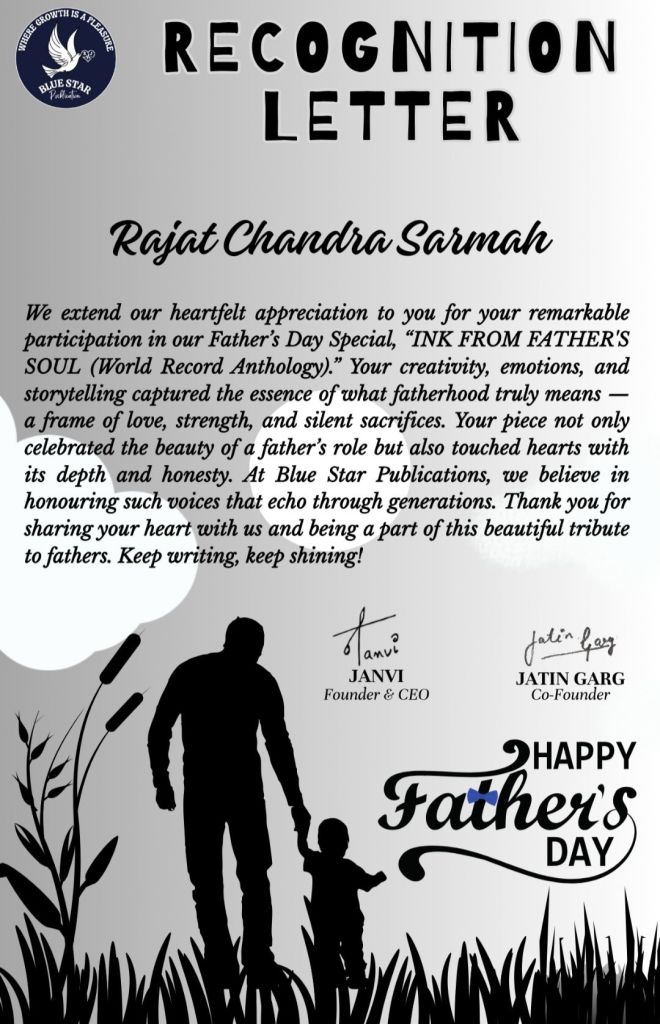
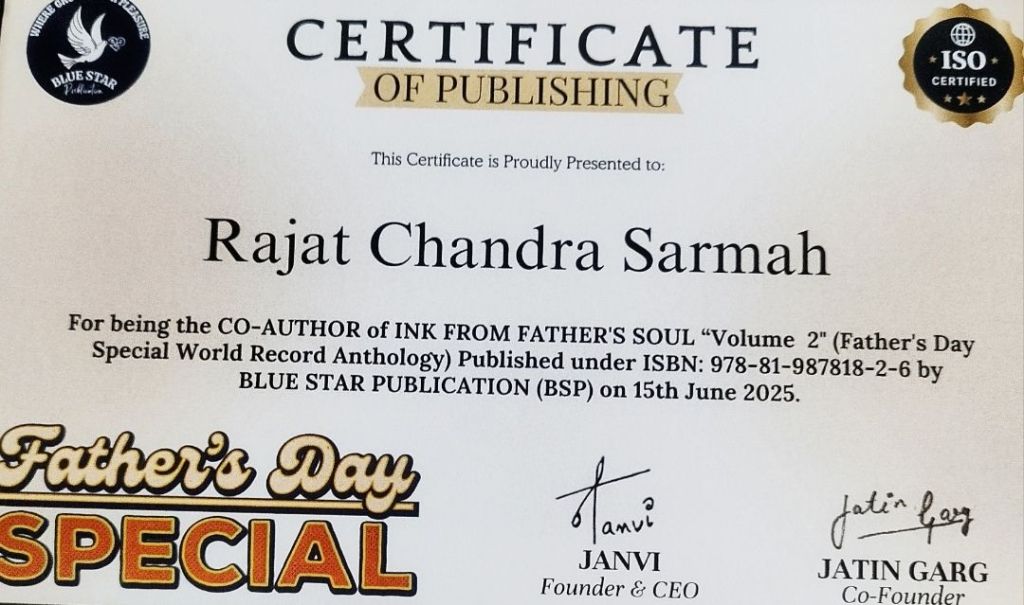
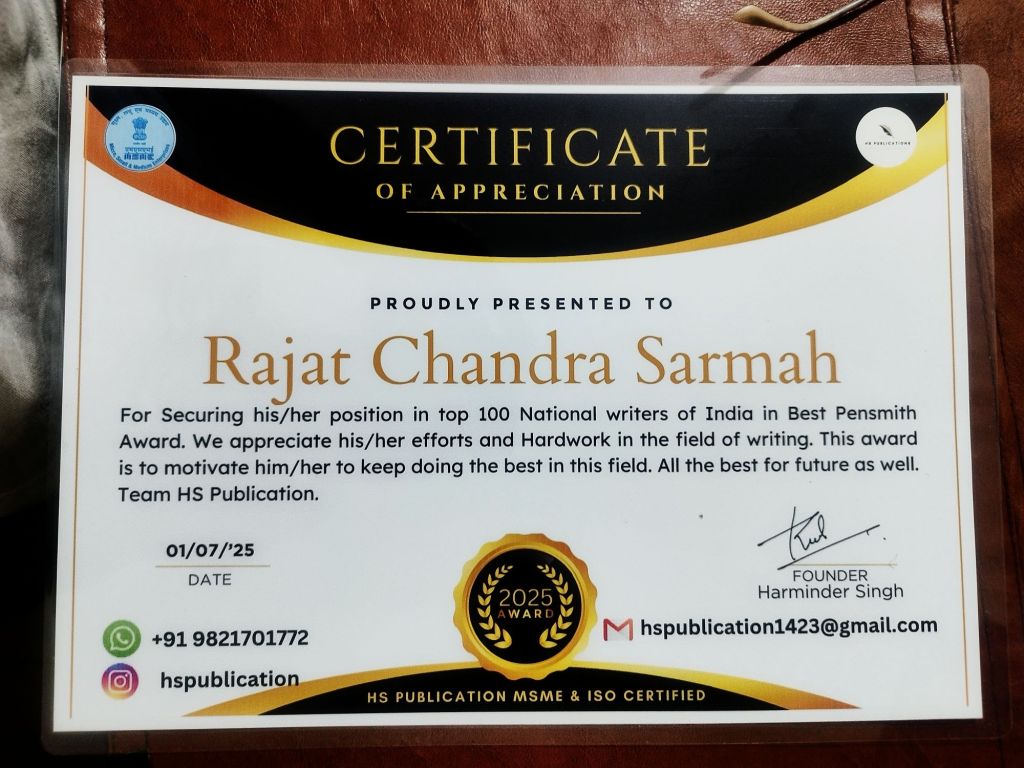
Recognisation

https://m.facebook.com/story.php?story_fbid=pfbid02uATvmmUj2VkmTaBb4gScZkR8WXbtVou8AVyQvA6L69oVcncLAtJh9ZnqTQpkDwHjl&id=100001535211165&sfnsn=wiwspmo&mibextid=RUbZ1f

LOVE ON A RAINY DAY

The sound of raindrops tapping on the windowpane and the CGI sheet roofing filled the cosy little cafe, creating a soothing symphony that seemed to echo the rhythm of my heart. I had always loved rainy days, the sound of raindrops on the roof is always so soothing to the ear.

 A beautiful young lady was sitting in front of me at a distance at the other corner of the cafe near the window. 

 Her lovely black long hair is open and dancing in the wind, her beautiful pair of black eyes captivating much like a piece of art, it is a rich deep shade of black that draws me in with its intensity creating a mesmerizing effect and leaving a lasting impression. The shape and expression of dark lashes light up with joy and warmth enjoying the rain outside. Each glance speaks volumes, telling a romantic story, framed by a delicate face with enchanting beautiful eyes with a pink cheek sparkled with every lightning flash outside. She was lost in thought, her fingers tracing the condensation trails on the glass.

I couldn’t help but be captivated by her presence, and a sudden surge of courage compelled me to approach her. With a friendly smile,I asked, “Mind if I join you?”

Startled, she looked up from the mesmerising raindrops. A smile crept across her face, and she nodded, welcoming his company. “Not at all. It’s nice to have some company on a day like this.”

As I settled into the seat in front of her, he introduced himself, “I’m Amrit.”

She extended her hand, “I’m Pori. Nice to meet you, Amrit.”

Our conversation flowed effortlessly as if we had known each other for years. We talked about our shared love for rainy days, favourite books, and childhood dreams. With each exchange, we discovered more things we had in common, deepening our connection.

Outside, the rain intensified, creating a cosy cocoon around us. The cafe’s soft lighting and the pitter-patter of raindrops made it feel like we were in our own world, far removed from the bustling city.

As the hours passed, we realized we had lost track of time. I, feeling a connection I hadn’t felt in years, leaned closer to Pori. “Would you like to go for a walk in the rain?”

Her eyes lit up with enthusiasm. “I’d love to.”

we paid our bill and stepped out into the downpour. The raindrops were cool and refreshing, drenching us in seconds. Pori’s laughter was like music, and I couldn’t help but join in.

We strolled along the wet streets, hand in hand, our fingers entwined. Raindrops clung to our hair and clothes, and we didn’t care. At that moment, we were free, immersed in the beauty of the rain and the joy of each other’s company.

We soon found shelter under a tree, our clothes clinging to our bodies, and our hearts pounding in their chests. The world seemed to fade away as we gazed into each other’s eyes, our faces inches apart. The anticipation of a kiss hung in the air, like the sweetest melody.

My fingers gently traced Pori’s cheek, and she closed her eyes, savouring the sensation. My lips met hers, and it was as if the rain had paused to witness our first kiss, the world hushed in reverence.

Our kiss deepened, and the raindrops continued to fall, washing away our inhibitions. Time seemed to slow down as their passion ignited, a beautiful flame fueled by the rain’s embrace.

Eventually, we broke the kiss, our foreheads resting against each other. I whispered, “I think I’ve fallen in love with you.”

Pori smiled, her large black eyes shining with affection. “I’ve fallen in love with you too, Amrit.”

At that moment, the rain gradually stopped, and the sun began to peek through the clouds, casting a warm, golden glow on the world around us. It was as if nature itself was blessing our love.

Hand in hand, we walked back to the cafe, our hearts overflowing with happiness. we knew that this rainy day had brought us a love as pure and beautiful as the raindrops that had brought them together.

Rajat

06/10/2023

Guwahati

A VISIT TO A CLINIC

I cautiously stepped into the bustling corridor of the hospital’s Outpatient Department (OPD), my heart pounding with a mixture of anticipation and trepidation. The sterile, clinical scent in the air made me momentarily hesitate, but I pressed on. This wasn’t my first time in a hospital, but it felt like the first day of school all over again. I couldn’t help but marvel at the opulence around me; it was as if I had walked into a five-star hotel, rather than a medical facility.

A vigilant security guard with full uniform, opened the door with a courteous nod as I approached the entrance. His uniform was pristine, his demeanour exuding professionalism. It was a reassuring sight, and I stepped inside with newfound confidence.

Just beyond the entrance, a welcoming lady stood behind a sleek counter, ready to assist incoming patients. She greeted us with a warm smile and asked the purpose of our visit. It was a simple question, yet it carried the weight of our health concerns. My companion and I exchanged glances before I replied, “We’re here to see Dr.Mahanta.”

Upon hearing our response, the lady efficiently collected our information and handed us a numbered coupon. We followed her directions to an adjacent waiting area, our designated spot until our coupon number was highlighted in the display. It was there that we found ourselves amidst a diverse group of people, each with their unique stories and anxieties, all bound together by the common thread of seeking medical care.

As I settled into our seats, I couldn’t help but observe the pace of the proceedings. At that moment, only one counter was operational, and a sense of sluggishness hung in the air. It was evident that the hospital was facing some logistical challenges, with the other counter remaining eerily vacant.

Minutes ticked away, and the slow-moving queue inched forward. Conversations buzzed around us as patients and their companions engaged in hushed exchanges. Some shared stories of previous visits, while others discussed their expectations for today’s appointment. Time seemed to stretch, and impatience began to gnaw at my nerves.

Soon two more counters opened and speed now is getting better. Eventually, after what felt like an eternity, our coupon number was displayed in the electronic board. We approached the designated desk, where a diligent clerk awaited our arrival. She seemed to possess an uncanny ability to extract all the necessary details swiftly, her fingers dancing across the keyboard as she recorded our information. In a matter of minutes, she handed us a meticulously prepared file and advised us to proceed to room number 18, where Dr. Mahanta would be available.

Before we left, we settled our registration fees at a nearby counter. The cashier handled our transaction with the same efficiency we had encountered earlier, leaving us with no further delay. Armed with our paperwork and a sense of purpose, we set off in search of room number 18.

The hospital’s layout was a maze of corridors and interconnected wings, but the signage was clear and concise. We navigated the labyrinthine hallways with ease, our anticipation building with every step. Finally, we arrived at room number 18, and my heart skipped a beat as I saw yet another desk in front of the closed door.

Patiently, we approached the desk, where a nurse sat, her gaze focused on her computer screen. She acknowledged our presence with a nod gestured for us to take a seat in the adjacent waiting area and collected the file we carried. It seemed that the journey was far from over; we were now in the hands of the medical staff, awaiting the arrival of Dr. Mahanta.

As we settled into the comfortable chairs, I couldn’t help but reflect on the intricate dance that was healthcare. From the security guard at the entrance to the clerk who meticulously recorded our information, every individual played a crucial role in this orchestrated symphony of care. Each step in the process, despite its occasional sluggishness, was proof of the dedication of the hospital’s staff with machine-like behaviour. The jurisdiction of each one is clearly defined.

Time passed in measured increments, punctuated by the soft hum of conversation and the distant echo of footsteps in the corridor. The minutes turned into an hour, and I found myself growing increasingly restless. I wondered about the doctor’s schedule, the challenges they faced each day, and the countless lives they touched.

As we settled in, the nurse assured us that the doctor would be with us shortly. The room was filled with the subtle hum of medical equipment, and the sterility of the surroundings served as a stark reminder of the purpose of our visit. Yet, there was an air of professionalism and competence that put us at ease. The nurse ushered us into the examination room and kindly instructed us to lie down on the crisp, white hospital bed. As we settled in, she began her routine check-ups, her movements precise and methodical.

First, she wrapped the blood pressure cuff around my arm, the rhythmic tightening and loosening of the cuff accompanied by the soft sound of the electronic monitor. She was beautiful and had a very pleasing smile that she carried all the time. I felt the gentle pressure on my arm, and I watched as the numbers on the screen fluctuated. The nurse, with a reassuring smile, noted down the blood pressure reading in my file.

Next, she directed her attention to the nearby scale. With careful precision, she asked me to step onto it, one by one. The digital display blinked momentarily, and our respective weights were recorded. The nurse’s professionalism and discretion put me at ease, despite the vulnerability that often accompanies medical examinations. With all the necessary data collected, the nurse meticulously arranged the file on the doctor’s table, ready for Dr. Mahanta’s evaluation. It was a moment of transition, where the information gathered during this initial assessment would become a crucial part of our medical history, guiding the doctor’s diagnosis and treatment plan.

Minutes later, Dr.Mahanta entered the room, exuding an aura of confidence and expertise. He greeted me with a warm smile and began to review the file that had been meticulously prepared by the earlier desk clerk and the nurse inside. Their attention to detail was evident as they asked probing questions about my medical history and current concerns. All are duly recorded in the file for the doctor to see, saving a lot of time for the doctor.

Dr. Mahanta’s presence commanded respect, and his warm demeanour put us at ease. He began the consultation by asking a series of detailed questions about the symptoms that had brought us to the hospital. His inquiries were thorough and pointed, leaving no stone unturned as he sought to understand the nature of my ailment.

With a measured tone, Dr. Mahanta inquired about our family’s medical history, recognizing the role that genetics can play in health issues. I shared what was asked, and each detail added to the growing picture of my medical profile.

Next, Dr. Mahanta conducted a physical examination, leaving no aspect of our health unexamined. They checked our eyes, carefully inspecting for any tell-tale signs of underlying issues. Their keen observation extended to our tongue, an often-overlooked indicator of certain health conditions.

With the stethoscope draped around their neck, Dr. Mahanta proceeded to perform a comprehensive abdominal examination. They pressed and probed from all sides, their trained hands seeking any abnormalities. The rhythmic whooshing and thumping of the stethoscope against my skin filled the room, a reminder of the precision with which they conducted their assessment.

The journey through the hospital had been a testimony to the dedication of its staff, from the vigilant security guard at the entrance to the efficient desk clerks and nurses who guided us along the way. At the heart of it all was Dr. Mahanta, a healthcare professional committed to providing the best possible care to their patients.

In a world where health is a precious commodity, the hospital had served as a sanctuary of care, where the pursuit of well-being was paramount as it looked to be. I was thinking about the care and professionalism that carried with the patients a newfound appreciation for the unsung heroes who work tirelessly behind the scenes to ensure that every patient’s journey is one of healing, hope, and compassion. All patients are equal and simply object to them with a tag and they are doing their duty as such with a smile always on their face like a machine obeying a command precisely.

Finally, Dr. Mahanta completed his examination and went to his chair and I was sitting in front. He turned his attention to me, his eyes meeting mine with a reassuring smile. He began to explain his assessment first-hand and outlined his recommended course of action. It was at this point that my expectations were met with a surprise.

Dr. Mahanta’s prescription was basically a list of advisories of various expensive tests and procedures as I had feared. He recommended meeting him again with all the test results, to facilitate him to prescribe after making a proper and final diagnosis. 

As I exited his chamber, I couldn’t help but reflect on the complex and interconnected web of individuals who had played a part in our healthcare journey to meticulous perfection giving us a feeling of five-star health care.

In a world where health is a precious commodity, the hospital has served as a sanctuary of care, where the pursuit of well-being should have been paramount but it seems that luxury in health care is equally important to provide a profitable business creating an environment of luxuries and professionalism and is possible only for the rich.

 As we stepped out into the bustling world beyond, I carried with me a very uncomfortable feeling and thinking about the poor who can not afford these luxuries and also have a lot of difficulties and overcrowding in the government health care system bringing the richer people to these luxurious services at a cost only they can afford. It is a win-win situation for both.  Compassionate health care moves to a big business proposition.

I decided not to do any of such expensive tests and decided to visit an old MBBS doctor who has a chamber nearby. After some wait, he started examining me in his chamber and prescribed two medicines to continue for a month and visit him after a month. I was very surprised and told him my story, a few hours back and showed him the prescription of Dr Mahanta. He looked at it with interest and said, no need to do any such test as I have a simple age and weather-related condition which should go out within a few days. he gives a meaningful look to my face. I showed my gratitude to him and left his place. with his medicine, I was fit within a week and coming back to my routine. I thought about Doctors like Dr Mahanta, who even having very high qualifications and knowing better than the MBBS doctor was compelled to prescribe all the available tests in their hospital to the patients only to run a five-star empire and become part of it forgetting the oath they took some time in their college days. 

A VISIT TO A CLINIC

I cautiously stepped into the bustling corridor of the hospital’s Outpatient Department (OPD), my heart pounding with a mixture of anticipation and trepidation. The sterile, clinical scent in the air made me momentarily hesitate, but I pressed on. This wasn’t my first time in a hospital, but it felt like the first day of school all over again. I couldn’t help but marvel at the opulence around me; it was as if I had walked into a five-star hotel, rather than a medical facility.

A vigilant security guard with full uniform, opened the door with a courteous nod as I approached the entrance. His uniform was pristine, his demeanour exuding professionalism. It was a reassuring sight, and I stepped inside with newfound confidence.

Just beyond the entrance, a welcoming lady stood behind a sleek counter, ready to assist incoming patients. She greeted us with a warm smile and asked the purpose of our visit. It was a simple question, yet it carried the weight of our health concerns. My companion and I exchanged glances before I replied, “We’re here to see Dr.Mahanta.”

Upon hearing our response, the lady efficiently collected our information and handed us a numbered coupon. We followed her directions to an adjacent waiting area, our designated spot until our coupon number was highlighted in the display. It was there that we found ourselves amidst a diverse group of people, each with their unique stories and anxieties, all bound together by the common thread of seeking medical care.

As I settled into our seats, I couldn’t help but observe the pace of the proceedings. At that moment, only one counter was operational, and a sense of sluggishness hung in the air. It was evident that the hospital was facing some logistical challenges, with the other counter remaining eerily vacant.

Minutes ticked away, and the slow-moving queue inched forward. Conversations buzzed around us as patients and their companions engaged in hushed exchanges. Some shared stories of previous visits, while others discussed their expectations for today’s appointment. Time seemed to stretch, and impatience began to gnaw at my nerves.

Soon two more counters opened and speed now is getting better. Eventually, after what felt like an eternity, our coupon number was displayed on the electronic board. We approached the designated desk, where a diligent clerk awaited our arrival. She seemed to possess an uncanny ability to extract all the necessary details swiftly, her fingers dancing across the keyboard as she recorded our information. In a matter of minutes, she handed us a meticulously prepared file and advised us to proceed to room number 18, where Dr. Mahanta would be available.

Before we left, we settled our registration fees at a nearby counter. The cashier handled our transaction with the same efficiency we had encountered earlier, leaving us with no further delay. Armed with our paperwork and a sense of purpose, we set off in search of room number 18.

The hospital’s layout was a maze of corridors and interconnected wings, but the signage was clear and concise. We navigated the labyrinthine hallways with ease, our anticipation building with every step. Finally, we arrived at room number 18, and my heart skipped a beat as I saw yet another desk in front of the closed door.

Patiently, we approached the desk, where a nurse sat, her gaze focused on her computer screen. She acknowledged our presence with a nod gestured for us to take a seat in the adjacent waiting area and collected the file we carried. It seemed that the journey was far from over; we were now in the hands of the medical staff, awaiting the arrival of Dr. Mahanta.

As we settled into the comfortable chairs, I couldn’t help but reflect on the intricate dance that was healthcare. From the security guard at the entrance to the clerk who meticulously recorded our information, every individual played a crucial role in this orchestrated symphony of care. Each step in the process, despite its occasional sluggishness, was proof of the dedication of the hospital’s staff with machine-like behaviour. The jurisdiction of each one is clearly defined.

Time passed in measured increments, punctuated by the soft hum of conversation and the distant echo of footsteps in the corridor. The minutes turned into an hour, and I found myself growing increasingly restless. I wondered about the doctor’s schedule, the challenges they faced each day, and the countless lives they touched.

As we settled in, the nurse assured us that the doctor would be with us shortly. The room was filled with the subtle hum of medical equipment, and the sterility of the surroundings served as a stark reminder of the purpose of our visit. Yet, there was an air of professionalism and competence that put us at ease. The nurse ushered us into the examination room and kindly instructed us to lie down on the crisp, white hospital bed. As we settled in, she began her routine check-ups, her movements precise and methodical.

First, she wrapped the blood pressure cuff around my arm, the rhythmic tightening and loosening of the cuff accompanied by the soft sound of the electronic monitor. She was beautiful and had a very pleasing smile that she carried all the time. I felt the gentle pressure on my arm, and I watched as the numbers on the screen fluctuated. The nurse, with a reassuring smile, noted down the blood pressure reading in my file.

Next, she directed her attention to the nearby scale. With careful precision, she asked me to step onto it, one by one. The digital display blinked momentarily, and our respective weights were recorded. The nurse’s professionalism and discretion put me at ease, despite the vulnerability that often accompanies medical examinations. With all the necessary data collected, the nurse meticulously arranged the file on the doctor’s table, ready for Dr. Mahanta’s evaluation. It was a moment of transition, where the information gathered during this initial assessment would become a crucial part of our medical history, guiding the doctor’s diagnosis and treatment plan.

Minutes later, Dr.Mahanta entered the room, exuding an aura of confidence and expertise. He greeted me with a warm smile and began to review the file that had been meticulously prepared by the earlier desk clerk and the nurse inside. Their attention to detail was evident as they asked probing questions about my medical history and current concerns. All are duly recorded in the file for the doctor to see, saving a lot of time for the doctor.

Dr. Mahanta’s presence commanded respect, and his warm demeanour put us at ease. He began the consultation by asking a series of detailed questions about the symptoms that had brought us to the hospital. His inquiries were thorough and pointed, leaving no stone unturned as he sought to understand the nature of my ailment.

With a measured tone, Dr. Mahanta inquired about our family’s medical history, recognizing the role that genetics can play in health issues. I shared what was asked, and each detail added to the growing picture of my medical profile.

Next, Dr. Mahanta conducted a physical examination, leaving no aspect of our health unexamined. They checked our eyes, carefully inspecting for any tell-tale signs of underlying issues. Their keen observation extended to our tongue, an often-overlooked indicator of certain health conditions.

With the stethoscope draped around their neck, Dr Mahanta proceeded to perform a comprehensive abdominal examination. They pressed and probed from all sides, their trained hands seeking any abnormalities. The rhythmic whooshing and thumping of the stethoscope against my skin filled the room, a reminder of the precision with which they conducted their assessment.

The journey through the hospital had been a testimony to the dedication of its staff, from the vigilant security guard at the entrance to the efficient desk clerks and nurses who guided us along the way. At the heart of it all was Dr. Mahanta, a healthcare professional committed to providing the best possible care to their patients.

In a world where health is a precious commodity, the hospital had served as a sanctuary of care, where the pursuit of well-being was paramount as it looked to be. I was thinking about the care and professionalism that carried with the patients a newfound appreciation for the unsung heroes who work tirelessly behind the scenes to ensure that every patient’s journey is one of healing, hope, and compassion. All patients are equal and simply object to them with a tag and they are doing their duty as such with a smile always on their face like a machine obeying a command precisely.

Finally, Dr. Mahanta completed his examination and went to his chair and I was sitting in front. He turned his attention to me, his eyes meeting mine with a reassuring smile. He began to explain his assessment first-hand and outlined his recommended course of action. It was at this point that my expectations were met with a surprise.

Dr. Mahanta’s prescription was basically a list of advisories of various expensive tests and procedures as I had feared. He recommended meeting him again with all the test results, to facilitate him to prescribe after making a proper and final diagnosis. 

As I exited his chamber, I couldn’t help but reflect on the complex and interconnected web of individuals who had played a part in our healthcare journey to meticulous perfection giving us a feeling of five-star health care.

In a world where health is a precious commodity, the hospital has served as a sanctuary of care, where the pursuit of well-being should have been paramount but it seems that luxury in health care is equally important to provide a profitable business creating an environment of luxuries and professionalism and is possible only for the rich.

 As we stepped out into the bustling world beyond, I carried with me a very uncomfortable feeling and thinking about the poor who can not afford these luxuries and also have a lot of difficulties and overcrowding in the government health care system bringing the richer people to these luxurious services at a cost only they can afford. It is a win-win situation for both.  Compassionate health care moves to a big business proposition.

I decided not to do any of such expensive tests and decided to visit an old MBBS doctor who has a chamber nearby. After some wait, he started examining me in his chamber and prescribed two medicines to continue for a month and visit him after a month. I was very surprised and told him my story, a few hours back and showed him the prescription of Dr Mahanta. He looked at it with interest and said, no need to do any such test as I have a simple age and weather-related condition which should go out within a few days. he gives a meaningful look to my face. I showed my gratitude to him and left his place. with his medicine, I was fit within a week and coming back to my routine. I thought about Doctors like Dr. Mahanta, who even having very high qualifications and was supposed to know better than the MBBS doctor was compelled to prescribe all the available tests in their hospital to the patients only to run a five-star empire and become part of it forgetting the oath they took some time in their college days. 

“Shifting Alliances: The Tale of Corporate Evolution”

Long ago, in a bustling corporate world, a group of fresh engineering recruits embarked on their professional journeys with bright eyes and high hopes, and I was a part of this group. They believed their batch was the best, fostering a sense of camaraderie and cooperation that seemed unbreakable.

As the years passed, they climbed the corporate ladder, and a subtle transformation began. The unity that once defined their group started to fragment gradually, and the distance between friends grew wider with each passing day. Doubt crept in, wondering if it was just a perception or a reality.

In the silent corners of my heart, I prayed it was just a feeling. But gradually, the truth became apparent. Some colleagues sought to cosy up to management to secure coveted positions and select places of posting, leading to changes in their behaviour and priorities. The younger generations emulated this shift, and the workplace dynamics evolved accordingly. Secretive, is the new word for the actions.

In the cutthroat corporate environment, it’s not uncommon to encounter individuals who are solely focused on their personal ambitions and career advancement. These individuals often exhibit several traits that set them apart. I was only hoping we would all be away from this corporate culture and make a difference as a young community.

But soon we felt, for some of us, the priority became the endless ascent in the corporate ladder, a choice posting, proximity to the management. They view their careers as a competition where only the strategist survives and quality takes a second seat. This intense ambition can lead to choices prioritising personal gain over ethical or empathetic considerations. The friendship and the closeness of the minds gradually evaporate and the corporate culture is seen as visible amongst the once close friends.

We become emotionally detached from our colleagues though externally we remain good friends but most see others as tools to be used to further their own goals, rather than as individuals with their own feelings and aspirations.

 While networking is essential in the corporate world, some often engage in it solely to enhance their own status and power. They form alliances not out of genuine friendship but as strategic moves to advance their careers.

Unfortunately, some individuals are willing to step on their colleagues or subordinates to reach the top. They may take credit for others’ work, spread rumours or engage in office politics to eliminate competition and disregard the impact of their actions on others.

These individuals often have a short-term perspective. They may prioritize immediate gains and promotions, ignoring the long-term consequences of their actions. This can lead to a lack of loyalty and trust among colleagues.

These characters often struggle to build authentic relationships. Their interactions with colleagues may be superficial, making it challenging to garner support or trust when needed.

Empathy, understanding, and emotional intelligence are often lacking in such individuals. They may not comprehend or care about how their decisions affect others emotionally.

Ironically, some of these individuals may achieve their career goals but find themselves lonely at the top. Their relentless pursuit of personal success may result in the alienation of potential allies and friends.

It’s essential to recognize that not everyone in the corporate world fits this description. Yet many individuals value meaningful relationships, teamwork, and ethical behaviour. However, encountering such characters may be heartening, but identifying them is essential to navigate such situations with caution. In the initial days, we were happy about the personal friendship, which has gradually changed and been taken over by the so-called corporate culture. This is nothing abnormal but not expected in the initial days of our career.

Those in positions of authority found themselves surrounded by eager colleagues, always ready to assist even in their personal matters, while those without power became isolated, their contributions overlooked. It was a stark reality that couldn’t be ignored. The weaker the management, the higher the number of flatterers.

The hard work and sacrifices made to build a cohesive team seemed futile. Loyalty wavered as people aligned themselves with those in power. It was a human characteristic, present everywhere, but it felt different from their initial perceptions when we began our careers.

One day, a retired CEO, once the centre of attention, made an unassuming visit to the office. The contrast was striking. The engineers who had once followed him and were ever ready to do anything for him now avoided, a poignant illustration of how quickly allegiances shift in the corporate world.

This encounter left a lasting impression on me, as I realized the importance of being prepared for solitude after retirement. People often failed to recognize that they too would face such a situation eventually.

I also faced these changes in the behaviour of people when transferred from one location to another. People from their previous workplaces began to forget soon, the help and assistance in working in various fields that were given them soon forgotten. For all, If they are posted without an authoritative position, they feel isolated. No one simply cares. Yet, if they come with authority, they again become a sought-after advisor for some other group of people and people running after them.

I was expecting some time to maintain connections, but the reality proved quicker than anticipated. Only a handful of true friends remained, who cherished relationships beyond corporate boundaries.

In this ever-evolving corporate landscape, what we learned about the value of resilience, adaptability, and cherishing true friendships has diminished and been replaced by individual goals only. Maybe all carried these lessons into retirement, where they found solace in the company of those few who had remained steadfast.

And so, the story of corporate life unfolded, a tale of shifting alliances and evolving relationships, reminding us all of the impermanence of power and the enduring significance of true friendships

It’s essential to recognize that not everyone in the corporate world fits this description. Many individuals value meaningful relationships, teamwork, and ethical behaviour. However, encountering pure-breed corporate characters can be disheartening, and it’s essential to navigate such situations with caution.

Ultimately, striking a balance between ambition and empathy is key to long-term success and fulfilment in the corporate world. While personal ambition can drive professional growth, it should not come at the cost of disregarding the emotional well-being of colleagues or sacrificing ethical principles. Building genuine relationships and fostering a supportive work environment can lead to more sustainable and satisfying career experiences instead of prioritizing climbing the ladder and ambition over genuine friendships and emotional consideration.

One day, all will be facing retirement, meaning genuine friendship and respect for the others will then be very badly missed.

Rajat

GuwahatI

16/09/2023