
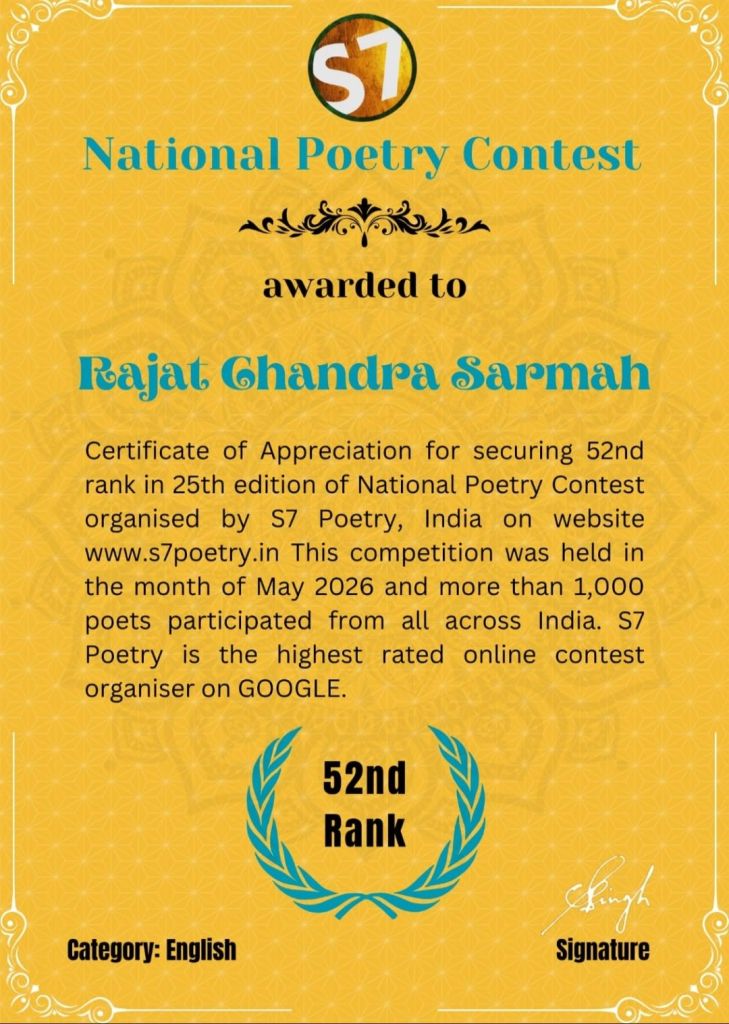
I am delighted and deeply honoured to be recognised by S7 Poetry in its 25th National Poetry Contest.

To be within the Top 100 poets once again is a privilege I never take for granted. What makes this recognition especially meaningful is the consistency of the journey—remaining within the first 100 ranks since the 19th edition of the contest, with my highest achievement being Rank 24.

Poetry is often a solitary pursuit, built quietly through observation, reflection, and persistence. Every recognition serves as encouragement to continue exploring the power of words and the human experience they seek to capture.

My sincere gratitude to S7 Poetry, the judges, organisers, fellow poets, and readers who keep the spirit of poetry alive. I look forward to continuing this journey, one poem at a time.

#Poetry #S7Poetry #NationalPoetryContest #PoetryRecognition #WritingJourney #PoetLife
The Clock That Has Been Running for Generations

Date: 07/06/2026

All Rights Reserved by the Author

In a small church in New Zealand stands a clock that has fascinated visitors for generations.

Unlike modern timepieces powered by batteries or electronics, this clock continues to operate through a mechanism that has endured for well over a century.

It requires regular winding and care, but its continued operation is a testament to craftsmanship and dedication.

What makes the story remarkable is not merely the clock itself.

It is the people who have maintained it.

Over the decades, different caretakers accepted responsibility for keeping the mechanism functioning. Knowledge was passed from one generation to the next, ensuring that the clock continued marking the passage of time.

In an age where many objects are discarded when they stop working, such traditions offer a different perspective.

Maintenance becomes an act of respect.

Repair becomes a form of stewardship.

The clock serves as a reminder that heritage is not only about preserving buildings or monuments.

It is also about preserving skills, knowledge and commitment.

Every tick represents more than the movement of gears.

It represents continuity.

A connection between those who cared for the clock in the past and those who continue to care for it today.

Rajat Chandra Sarmah
Guwahati, Assam, India
email: rajatchandrasarmah@gmail.com
youtube: conversewithasmile

#HeritageStories
#LivingHistory
#Craftsmanship
#WorldCulture
#NewZealand
#ConverseWithASmile

The Empty Chair at the Reunion


Date: 07/06/2026
All Rights Reserved by the Author


“How lucky I am to have something that makes saying goodbye so hard.” — A. A. Milne
A group of old friends gathered for their annual reunion.
The conversations began exactly where they had ended the previous year.
Stories were retold.
Laughter returned.
Memories travelled easily across decades.
Yet this year, one chair remained empty.
A friend who had attended every reunion was no longer there.
For a moment, the absence felt larger than the room itself.
Then something beautiful happened.
People began sharing stories about him.
His jokes.
His habits.
The time he arrived at the wrong venue.
The way he remembered everyone’s birthday.
Soon the empty chair no longer seemed empty.
It had become filled with memories.
Life teaches us that people leave.
But it also teaches us something equally important.
The kindness we give, the laughter we share and the lives we touch often remain long after we are gone.
Perhaps that is why memories matter so much.
They allow presence to outlive absence.
And sometimes, they turn an empty chair into the most occupied seat in the room.


Rajat Chandra Sarmah Guwahati, Assam, India email: rajatchandrasarmah@gmail.com youtube: conversewithasmile

The Dog Who Led Them Home


Date: 06/06/2026
All Rights Reserved by the Author


A family hiking in unfamiliar countryside took a wrong turn as daylight began to fade.
The trails looked similar.
The signposts became confusing.
As concern grew, their dog suddenly became unusually determined.
Instead of following the family, he began walking ahead, frequently looking back as if checking whether they were following.
The family decided to trust him.
For nearly twenty minutes the dog continued along a narrow path before emerging onto a familiar trail leading back toward the visitor centre.
Whether the animal consciously understood the situation or simply recognized a scent, nobody could say with certainty.
What mattered was the outcome.
The family returned safely before darkness settled across the landscape.
Stories like this explain why people often describe dogs as companions rather than pets.
A strong bond develops when humans and animals share daily experiences, trust and affection.
Sometimes that trust reveals itself in remarkable ways.
And occasionally, when uncertainty appears, guidance arrives on four legs with a wagging tail.


Rajat Chandra Sarmah Guwahati, Assam, India email: rajatchandrasarmah@gmail.com youtube: conversewithasmile

The Library Carved Into a Mountain


Date: 06/06/2026
All Rights Reserved by the Author


High in the cliffs of China’s ancient Buddhist regions, generations of monks and scholars preserved knowledge in extraordinary ways.
Among the most remarkable were collections of manuscripts and sacred texts stored within cave complexes carved directly into mountainsides.
These were not merely places of worship.
They became centres of learning, translation and preservation.
For centuries, travellers, monks and scholars carried texts across deserts, mountain passes and trade routes. Many of these writings might have vanished forever had they not been protected within these remote stone chambers.
The caves provided natural insulation from weather and offered security during turbulent periods of history.
What makes these sites fascinating is the effort invested in preserving ideas.
The people who copied and protected these manuscripts often knew they would never see the full impact of their work.
Yet they continued.
Their reward was not recognition.
It was continuity.
Today, historians continue to study these collections, uncovering insights into religion, trade, language and daily life from centuries ago.
The story reminds us that civilization depends not only on those who create knowledge, but also on those who preserve it.
Sometimes the future is safeguarded by people who quietly protect the past.


Rajat Chandra Sarmah Guwahati, Assam, India email: rajatchandrasarmah@gmail.com youtube: conversewithasmile

#heritageStories #WorldCulture #HistoryMatters #AncientKnowledge #CulturalHeritage #ConverseWithASmile

The Voicemail Nobody Deleted


Date: 06/06/2026
All Rights Reserved by the Author


“Sometimes you will never know the value of a moment until it becomes a memory.” — Dr. Seuss
A man changed his phone after many years.
Before transferring his data, he noticed an old voicemail.
It was from his father.
The message was ordinary.
“Call me when you reach home.”
Nothing more.
No life lesson.
No profound advice.
Just a routine message left on an ordinary day.
His father had passed away several years earlier.
The man listened to the recording again.
Then once more.
And again.
What had once seemed insignificant had become priceless.
Most of life’s treasures do not announce themselves when they arrive.
A casual conversation.
A familiar greeting.
A shared meal.
A voice heard every day.
Only later do we understand their true value.
Perhaps that is why gratitude matters.
Not for the extraordinary events that occur once in a lifetime.
But for the ordinary moments that quietly become irreplaceable.


Rajat Chandra Sarmah Guwahati, Assam, India email: rajatchandrasarmah@gmail.com youtube: conversewithasmile

The Cat at the Library


Date: 05/06/2026
All Rights Reserved by the Author


Visitors to a small town library began noticing a cat that appeared almost every afternoon.
Nobody knew exactly when the habit started.
The cat would quietly enter through an open door, wander among the shelves and eventually settle near the reading area.
Children loved it.
Older visitors looked for it whenever they arrived.
The librarians eventually accepted the cat as an unofficial member of staff.
Over time, something unexpected happened.
People started talking more.
Strangers exchanged smiles.
Children who were nervous about reading aloud became more relaxed.
The cat seemed unaware of its influence.
It simply followed its daily routine.
Yet its presence created a sense of comfort that many visitors appreciated.
Animals often contribute to our lives in subtle ways.
They do not solve our problems or offer advice.
But they remind us to slow down, observe and share simple moments.
The library still contains thousands of books.
Yet for many visitors, one of its most memorable stories has four paws and a tail.


Rajat Chandra Sarmah Guwahati, Assam, India email: rajatchandrasarmah@gmail.com youtube: conversewithasmile

The Wooden Churches of Norway


Date: 05/06/2026
All Rights Reserved by the Author


Across the valleys and forests of Norway stand some of the most distinctive wooden churches ever built.
Known as stave churches, these structures date back hundreds of years and represent a remarkable blend of craftsmanship, faith and engineering.
Built almost entirely from timber, many have survived harsh winters, storms and centuries of changing history. Their steep roofs, intricate carvings and dragon-like decorations reveal influences from both Christian traditions and earlier Norse culture.
What makes these churches particularly fascinating is the skill of the builders.
Without modern machinery, they developed techniques that allowed wooden structures to remain strong and flexible. Many of the original beams still stand today.
The churches were more than places of worship.
They served as gathering points where communities celebrated milestones, resolved disputes and shared news.
In a rapidly changing world, these buildings remind us of the value of durability.
Not just in construction, but in culture.
The craftsmen who built them could never have imagined visitors admiring their work centuries later.
Yet their dedication transformed simple timber into a lasting legacy.
Sometimes the most enduring monuments are not those built from stone.
They are those built with patience.


Rajat Chandra Sarmah Guwahati, Assam, India email: rajatchandrasarmah@gmail.com youtube: conversewithasmile

HeritageStories #WorldCulture #Norway #HistoricArchitecture #LivingHistory #ConverseWithASmile

The Last Page


Date: 05/06/2026
All Rights Reserved by the Author


“Life is what happens while you are busy making other plans.” — John Lennon
A woman was cleaning her bookshelf when she found an old novel she had not opened in years.
The story itself had faded from memory.
But as she turned the pages, something unexpected slipped out.
A receipt.
A train ticket.
A small handwritten note.
Suddenly, the book became more than a book.
It became a time machine.
She remembered where she had been living when she first read it. She remembered the friend who had recommended it. She even remembered the café where she had finished the final chapter.
Books have an unusual gift.
They preserve not only stories but fragments of our own lives.
Years later, we may forget the plot, yet remember the season in which we read it.
Perhaps life works in a similar way.
When we reach our final chapters, we may not remember every detail.
But we will remember the people, places and moments that gave meaning to the pages.
And that may be enough.


Rajat Chandra Sarmah Guwahati, Assam, India email: rajatchandrasarmah@gmail.com youtube: conversewithasmile

The Horse That Waited


Date: 04/06/2026
All Rights Reserved by the Author


For years, a retired farmer visited the same pasture every evening.
There he would spend a few quiet minutes with a horse that had worked alongside him for much of his life.
Age had slowed them both.
The farmer no longer managed fields. The horse no longer pulled equipment or carried loads.
Yet their routine continued.
One winter, illness kept the farmer away for several days.
Neighbours who cared for the horse noticed something unusual.
The animal repeatedly walked to the gate around the time the farmer normally arrived.
It would stand there for a while, looking down the road before returning to the pasture.
When the farmer finally recovered and returned, the horse approached him immediately.
No words were exchanged.
None were needed.
Relationships between humans and animals are often built through thousands of small interactions rather than dramatic events.
A shared routine.
A familiar voice.
A trusted presence.
Perhaps loyalty is not measured only by what happens during extraordinary moments.
Sometimes it reveals itself in the simple act of waiting.


Rajat Chandra Sarmah Guwahati, Assam, India email: rajatchandrasarmah@gmail.com youtube: conversewithasmile