Good morning to my readers and friends

In Sri Lanka , a few years back .

Recap of My Earlier Posts on Leadership vs. Management

(C) All right reserved by the author)

Instagram :@rajatchandrasarmah5

Before moving forward, let’s first revisit what I had already shared. Below, I’ve summarized the key points from Serial 1 to 28—the points I had already published here earlier . This will help us to proceed further in a better way for clarity perhaps .

Brief Quotes (Serial 1 to 10)

  1. Management and leadership, though often used interchangeably, are fundamentally different.
  2. Managers ensure stability; leaders drive change.
  3. A manager organizes work; a leader inspires people.
  4. Leadership is about vision, while management is about execution.
  5. A leader influences minds; a manager influences systems.
  6. Managers prioritize efficiency; leaders prioritize innovation.
  7. A leader dares to challenge the status quo; a manager ensures compliance.
  8. Management is about tasks; leadership is about people.
  9. Not all managers are leaders, but great leaders manage well.
  10. A manager assigns roles; a leader builds confidence.

I will take up 11 to 28  in my next post.

RAJAT CHANDRA SARMAH

GUWAHATI , ASSAM , INDIA

12/02/2025

Good Morning friends and my readers .

Leadership vs. Management: A Quick Recap Before Moving Forward

( c ) All right reserved by the author

Instagram : @rajatchandrasarmah5

I am constantly being reminded by some of my friends and readers to continue my writing on the above subject . I wrote on the topic purely  as I learned from my 36 years of corporate experience , most of them in project construction and later as Project Head and Head of various corporate departments . So my views may not be as per the text book of management . 

When I first started this series, my intention was simple—to differentiate between leadership and management in a way that resonates with real-life experiences. Many people use these terms interchangeably, but they are vastly different in essence.

A manager ensures stability, keeping things running as they should. A leader, however, is a force of change, inspiring others to think beyond the routine. Leadership isn’t just about assigning tasks; it’s about igniting confidence in people. While a manager may give orders and expect compliance, a leader makes people want to follow—not out of obligation, but because they believe in the vision.

I have always felt that a leader’s success isn’t measured in numbers but in the impact they leave behind. A great leader doesn’t just manage well—they create more leaders. They challenge the status quo, look beyond rules, and connect with people on an emotional level.

A manager works within systems, ensuring everything functions smoothly. A leader builds cultures, shaping mindsets and nurturing growth. While managers thrive on structure and control, leaders embrace uncertainty, knowing that real progress often comes from stepping into the unknown.

Looking back at what I had shared before, I realize that leadership is about trust, empowerment, and vision. It’s about listening, not just commanding. A leader doesn’t just handle responsibilities—they cultivate potential in others.

With this foundation, I am excited to continue this discussion. In the coming posts, I will delve deeper into practical leadership insights, how leadership qualities can be developed, and real-world examples that distinguish true leaders from mere managers.

Stay with me on this journey, and let’s explore leadership beyond the textbook.

RAJAT CHANDRA SARMAH

GUWAHATI , ASSAM , INDIA

11/02/2025

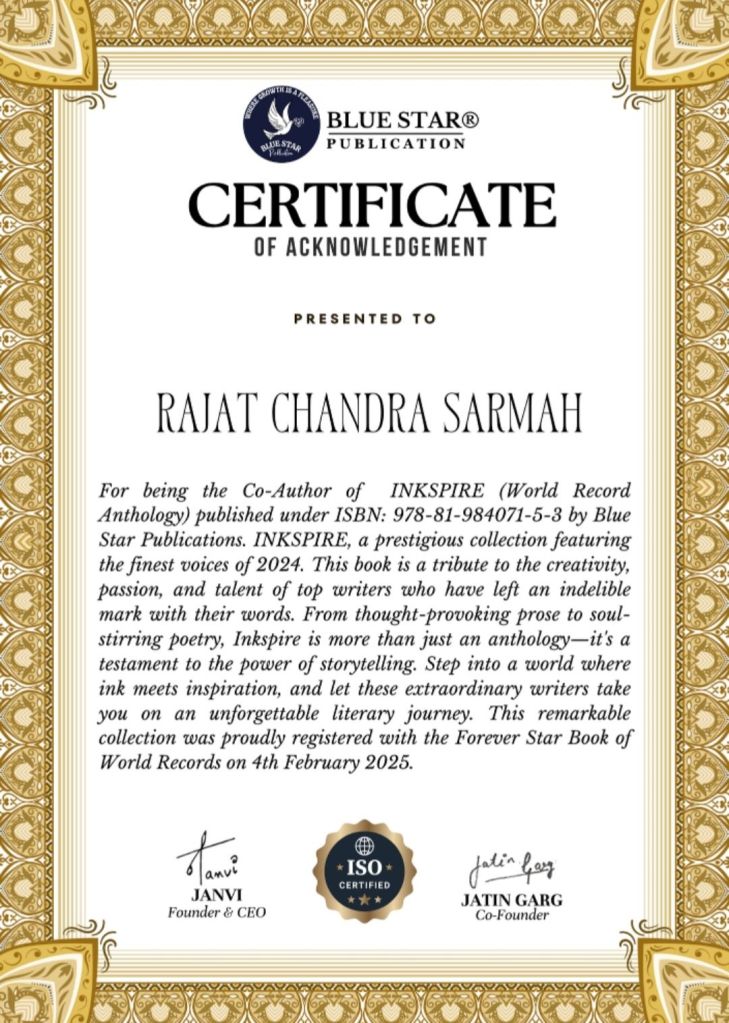
Inkspire World record Anthology now published after a national level writing competition (where I got Rank -2)

A proud achievement for me

Day 4: The Cost of Truth

( c)All rights reserved by the author

Instagram : rajatchandrasarmah5

Email: rajatchandrasarmah@gmail.com

We are taught that honesty is a virtue, that truth is the foundation of trust, and that lies—no matter how small—erode relationships, break families, and corrode societies. But is truth always the right path? And does honesty always serve a purpose?

I once knew a man who lived his life with unwavering integrity. A professor, admired for his wisdom, respected for his principles. He believed in truth—not just as a moral choice, but as an obligation. He never bent reality to make life easier, never softened his words to spare feelings.

One day, a student approached him after class, full of anxiety. She had spent years pursuing a subject she no longer loved, struggling, yet unable to quit due to family pressure. She asked the professor, “Do you think I have a future in this field?”

He looked at her, sighed, and said, “No. You lack the aptitude, and more importantly, the passion. You should consider something else.”

She nodded, thanked him, and walked away.

Weeks later, the news came—she had taken her own life. A note was found beside her, with only a few words: “I was never good enough.”

The professor never spoke about it, but something in him changed. His lectures became shorter, his eyes heavier. He still believed in truth, but I often wondered—did he ever question its worth?

We say that truth is essential, but must it always be spoken? Is honesty a responsibility, or does it sometimes do more harm than good?

Should we always tell the truth, no matter the consequences? Or are there moments when silence—or even a lie—becomes the kinder choice?

RAJAT CHANDRA SARMAH

GUWAHATI , ASSAM , INDIA

10/02/2025

Good Morning Friends

The sound of Silence , tell all you need . Relaxed

Day 3: Justice or Revenge?

( c)All rights reserved by the author

Instagram : rajatchandrasarmah5

Email: rajatchandrasarmah@gmail.com

We all believe in justice. It is the foundation of a civilized world—the idea that right will prevail and wrong will be punished. But sometimes, justice takes too long. And sometimes, the lines between justice and revenge blur until they become indistinguishable.

Years ago, I knew a man—kind, hardworking, the sort of person who never raised his voice, even when wronged. He built a small business from nothing, spending decades nurturing it with honesty and perseverance. But the world is not always kind to good people. A powerful competitor, backed by influence and money, saw him as an obstacle. Through deception and corruption, they ruined him—stole his clients, tarnished his reputation, even manipulated the legal system against him.

And so, he lost everything.

At first, he tried to fight within the system. He believed that truth would eventually win. But truth, it seemed, was not enough. Every door he knocked on was already closed. Every plea fell on deaf ears. Justice remained an unfulfilled promise, while the one who wronged him thrived.

Then something changed. The quiet, kind man became someone else. He no longer spoke of fairness—only retribution. He waited, watched, gathered information. Slowly, methodically, he struck back. He didn’t break the law, but he found ways to make his enemy suffer—exposing hidden fraud, whispering secrets to the right ears, using the same manipulations that had once destroyed him.

The competitor eventually fell, not by law but by carefully placed ruin. My friend regained his lost reputation, but I noticed something in his eyes—an emptiness, a weariness. He had won, but had he?

Was this justice, or was it simply revenge?

And is there a difference?

If the system fails, do we have the right to take matters into our own hands? Or does fighting wrong with wrong make us no different from those we stand against?

Rajat Chandra Sarmah

Guwahati , Assam , India

09/02/2025

Morning with Pigeon and monkeys .

Good morning to all my friends and readers

Day 2: The Price of Dreams

( c)All rights reserved by the author

Instagram : rajatchandrasarmah5

Email: rajatchandrasarmah@gmail.com

Dreams are what give life meaning. They push us forward, make us strive for something beyond the ordinary. But what happens when the pursuit of a dream comes at a cost too great to bear?

I have seen this struggle up close.

A close friend of mine, a devoted father, spent his entire life working toward a single purpose—to give his son the future he never had. From the moment the child was born, every decision revolved around him. The best schools, the best coaching, the best opportunities—no expense was too great, no sacrifice too small.

And the boy had a dream too. He wanted to study abroad, to make a name for himself in a world far removed from the quiet life his parents had known. His father embraced this dream as his own. He worked overtime, took out loans, cut down on every personal expense imaginable. Family vacations became a thing of the past. Even medical checkups were postponed. He aged before his time, his health suffering in silence, his only comfort being the thought that one day, his son would achieve greatness.

The day finally came. The boy left for his dream university. The father stood at the airport, his eyes filled with both pride and exhaustion. Months passed, then years. The boy flourished in his new world, his visits home growing less frequent. Life moved on, but the sacrifices remained. The father, now much older, had given away his best years. The loans still needed repayment, the body still bore the burden of overwork.

One evening, he sat with me and asked, almost as if speaking to himself, “Did I do the right thing? Was it worth it?”

And I didn’t know what to say.

Is it right for a parent to give up everything for a child’s dream, even at the cost of their own well-being? Should there be a limit to sacrifice, or is true love defined by boundless giving?

What do you think? Should dreams always come first, no matter the cost? Or should there be a balance between ambition and the life that is slipping away in its pursuit?

Rajat Chandra Sarmah

Guwahati , Assam , India

08/02/2025