
The Whale That Leaves Scientists Guessing

All rights reserved by the author
22 September 2026

Humpback whales are not short of ways to surprise us.

They sing. They breach. They slap their tails on the water.

And sometimes, they simply open their enormous mouths and hold them there.

Scientists call this behaviour “gaping”. It has been observed in humpback whales, but it is unusual enough that researchers still do not have a definite explanation for it.

It may have something to do with communication. It may be a form of play. It could even be a way of stretching the jaw.

What makes the story particularly interesting is how researchers are learning about it.

Instead of relying only on organised scientific observations, they have been examining photographs and videos taken by tourists and shared on social media. Those ordinary holiday photographs have given researchers more examples of a behaviour that is rarely recorded.

So somewhere, among thousands of photographs taken simply because someone happened to see a whale, there may be another small clue.

Nature does that to us.

Just when we think we know an animal, it gives us something that makes us look again.

And perhaps that is one of the pleasures of the natural world.

It still has secrets.

Rajat Chandra Sarmah, Guwahati, Assam, India, Instagram @rajatchandrasarmah5, YouTube: conversewithasmile, email rajatchandrasarmah@gmail.com
Guinea-Bissau: The Islands That Belong to the Tide

All rights reserved by the author
22 September 2026

Off the coast of Guinea-Bissau lies an extraordinary world of islands, mangroves, mudflats and shifting channels.

The Bijagós Archipelago does not look like a place designed for a postcard. It feels much older than that.

The islands are shaped by the tide, and life here has long been closely connected with the sea, the forests and the rhythms of the seasons. Traditional communities have played an important role in protecting these landscapes, using local knowledge to manage natural resources.

The archipelago is also remarkable for its wildlife. Green and leatherback turtles come ashore to nest, while dolphins, manatees and large numbers of migratory shorebirds use its waters and wetlands.

In 2025, UNESCO inscribed the Coastal and Marine Ecosystems of the Bijagós Archipelago—Omatí Minhô on the World Heritage List, recognising its exceptional marine and intertidal ecosystems. UNESCO describes it as the only active deltaic archipelago on Africa’s Atlantic coast.

Perhaps the most interesting thing about Guinea-Bissau is that its natural wealth has survived not because the landscape was separated from its people, but partly because communities have learned to live with it.

Here, the tide is not simply something that comes and goes.

It is part of life.

#GuineaBissau #Bijagos #WorldHeritage #RajatChandraSarmah

Rajat Chandra Sarmah, Guwahati, Assam, India, Instagram @rajatchandrasarmah5, YouTube: conversewithasmile, email rajatchandrasarmah@gmail.com

The Years That Change Us

All rights reserved by the author
22 September 2026

There comes a time when we stop measuring life only by what we have achieved.

We begin to remember other things.

The person who stood beside us when we were going through a difficult time. The friend whose phone call came exactly when we needed it. The afternoon we spent doing absolutely nothing, yet somehow remember years later.

When we are young, we often think life is waiting somewhere ahead. There will be more time, more journeys, more conversations, more chances to say what we meant to say.

Then the years quietly teach us something else.

Life is not only what happens next. It is also what is happening now, while we are busy thinking about what comes next.

Perhaps that is why ordinary days become more precious with age.

A cup of tea with someone we love. A familiar voice from another room. Rain against the window. A message from an old friend.

Nothing extraordinary.

And yet, these may be the pieces we remember most.

Rajat Chandra Sarmah, Guwahati, Assam, India, Instagram @rajatchandrasarmah5, YouTube: conversewithasmile, email rajatchandrasarmah@gmail.com

The Bird That Sleeps While Flying

All rights reserved by the author
21 September 2026

Imagine being thousands of feet above the ocean, with nowhere to land, and becoming sleepy.

That is not a problem for the great frigatebird.

These remarkable seabirds can remain in the air for days while travelling over the ocean. In 2016, scientists recorded the brain activity of great frigatebirds during long flights and confirmed something that sounds almost impossible: the birds can sleep while flying.

Sometimes one side of the brain sleeps while the other remains awake. At other times, both sides sleep.

They do not, however, sleep very much. During flight, the birds slept for only a small fraction of their time, usually in short periods, often while circling in rising air currents.

There is something wonderfully strange about that.

Most of us need a bed, a pillow and a quiet room before we can surrender to sleep.

The frigatebird simply finds a current of air, folds its attention inward for a moment, and keeps travelling.

Perhaps nature has a way of reminding us that there is more than one way to rest.

And sometimes, you can even rest without stopping.

Rajat Chandra Sarmah, Guwahati, Assam, India, Instagram @rajatchandrasarmah5, YouTube: conversewithasmile, email rajatchandrasarmah@gmail.com

Sierra Leone: Where a Forest Became a Second Chance

All rights reserved by the author
21 September 2026

On the outskirts of Freetown, in the forested hills of Sierra Leone, there is a place where some of the country’s most vulnerable animals have been given another chance.

It is called Tacugama Chimpanzee Sanctuary.

The sanctuary was founded in 1995 by Bala Amarasekaran and his wife, Sharmila, initially to rescue and rehabilitate orphaned Western chimpanzees. Over the years, it grew into a wider conservation organisation, working not only with animals but also with communities, schools and forests.

One incident from its history is almost unbelievable.

On 23 April 2006, 31 chimpanzees escaped from the sanctuary. Within two weeks, 21 had returned. Remarkably, 19 of them came back on their own. After two months, 26 were back.

There is something moving about that story.

We often speak of a sanctuary as a place that keeps animals safe. But sometimes it becomes something more. A place remembered as home.

Sierra Leone has also given the chimpanzee an extraordinary place in its national identity. The country declared it its national animal in 2019, and the chimpanzee later appeared on its passports.

Perhaps conservation is not only about protecting wildlife.

Sometimes, it is about giving a living creature the chance to belong somewhere again.

#SierraLeone #WildlifeConservation #Africa #RajatChandraSarmah

Rajat Chandra Sarmah, Guwahati, Assam, India, Instagram @rajatchandrasarmah5, YouTube: conversewithasmile, email rajatchandrasarmah@gmail.com

The Things We Understand Later

All rights reserved by the author
21 September 2026

There are things in life we understand only after they have passed.

A conversation we thought was ordinary. A goodbye we did not know was final. A kindness we barely noticed at the time. Even a difficult period that once seemed pointless can look different when we stand far enough away from it.

Perhaps that is one of the quiet privileges of growing older. We begin to see the shape of things that were once too close to understand.

Sometimes we remember a person and realise that what mattered was not what they said, but the way we felt when they were around. Sometimes we look back at a decision we once regretted and discover that it quietly brought us somewhere we needed to be.

Life rarely explains itself while we are living it.

It asks us to keep going without giving us the whole picture.

And perhaps that is why, when we look back, certain memories carry a strange tenderness. We finally understand what they were trying to tell us.

Rajat Chandra Sarmah, Guwahati, Assam, India, Instagram @rajatchandrasarmah5, YouTube: conversewithasmile, email rajatchandrasarmah@gmail.com

The Goat That Climbs Trees

All Rights Reserved by the Author
20 September 2026

Most of us have seen goats climb onto rocks.

But some goats take climbing rather more seriously.

In Morocco, goats are sometimes seen climbing argan trees, carefully balancing on branches several metres above the ground.

The sight looks almost impossible the first time you see it.

The goats climb because they are attracted to the leaves and fruit of the argan tree. The trees themselves are well adapted to the dry environment of southwestern Morocco.

For generations, local communities have lived alongside these trees, which are important for both the ecosystem and the production of argan oil.

The goats, meanwhile, have acquired a reputation of their own.

They climb.

They balance.

They eat.

And apparently they have no particular interest in what we think goats are supposed to do.

There is something wonderfully reassuring about that.

Every species has its own way of making sense of the world.

A goat does not need to behave like a horse.

A crow does not need to behave like a parrot.

And perhaps humans could occasionally take the same advice.

We spend so much time trying to fit into expectations.

The goats seem to have solved the problem.

Find a tree.

Climb it.

Have lunch.

Rajat Chandra Sarmah
Guwahati, Assam, India
Instagram @rajatchandrasarmah5
YouTube: conversewithasmile
Email: rajatchandrasarmah@gmail.com

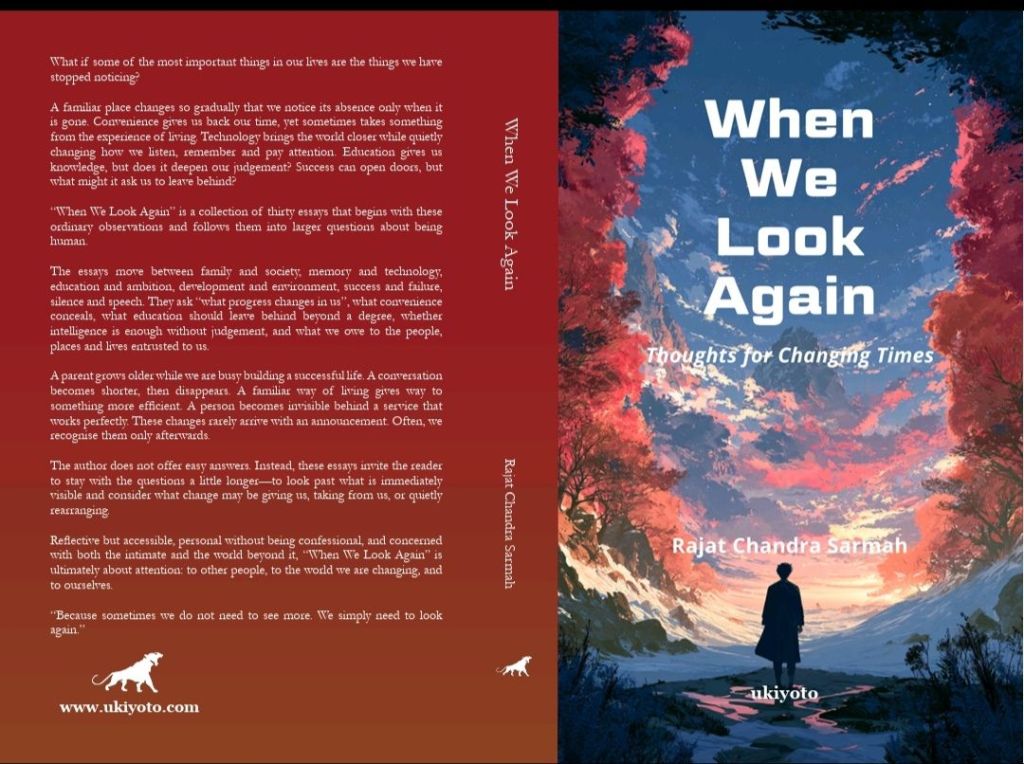
My latest book is in stores now .

I am happy to share something that is very close to my heart.

My new book, WHEN WE LOOK AGAIN, has now been published.

Every book leaves something of its author behind. This one is no different. It has grown out of thoughts, observations, memories and those small moments in life which sometimes stay with us much longer than we expect.

I chose the title When We Look Again because I have come to believe that time changes the way we see things. A person we once knew, a decision we once made, a relationship, a memory—even a part of ourselves—may look quite different when we return to it after some years.

Perhaps that is what growing older really gives us: not all the answers, but the ability to see some things with a little more understanding.

I have written this book with that feeling.

I am not sure what every reader will find in its pages. That is perhaps the most beautiful part of writing. Once a book leaves the author, it begins another journey in the minds and hearts of its readers.

So, with a little happiness, a little nervousness, and a great deal of gratitude, I place WHEN WE LOOK AGAIN before you.

I hope you will read it.

And perhaps, somewhere along the way, it will make you look again at something you thought you already knew.The book is presently available in the following link and will be available in Amazon very soon .

https://www.ukiyotoindia.com/product-page/when-we-look-again

Montenegro: The Bay That Looks Like a Fjord

All Rights Reserved by the Author
20 September 2026

On the Adriatic coast of Montenegro lies a remarkable landscape where mountains seem to fall directly into the sea.

It is the Bay of Kotor, a winding body of water surrounded by steep mountains and small historic settlements.

At first sight, it can look almost like a Norwegian fjord.

But geologically, it is different. The bay is a deeply indented part of the Adriatic coastline, shaped by a complex combination of geological processes and river valleys.

Along its shores are old stone towns, churches and fortifications, reflecting centuries of Mediterranean history.

Among them is Perast, a small settlement whose waterfront faces two distinctive islands, one of them home to the church of Our Lady of the Rocks.

What makes the region memorable is the way nature and human history sit so closely together.

Mountains provide the dramatic backdrop.

The sea provides the route.

And centuries of people have built their homes, churches and towns between the two.

Montenegro may be small on the map, but landscapes such as the Bay of Kotor remind us that size is a poor measure of character.

Sometimes a small country can contain an extraordinary amount of history within a very small space.

#Montenegro #Kotor #Adriatic #RajatChandraSarmah

Rajat Chandra Sarmah
Guwahati, Assam, India
Instagram @rajatchandrasarmah5
YouTube: conversewithasmile
Email: rajatchandrasarmah@gmail.com

There Are Still Roads We Have Not Taken

All Rights Reserved by the Author
20 September 2026

Sometimes I look back at the roads I did not take.

Not with regret, exactly.

More with curiosity.

What would life have been like if I had said yes to that opportunity? What if I had gone to that place? What if I had met that person at a different time?

We can never know.

Life gives us one road at a time, and once we have walked it for long enough, the roads behind us become stories rather than possibilities.

But there is something comforting about realising that the road ahead is still there.

We may not be young anymore. We may have responsibilities, habits and a fairly good idea of what tomorrow will look like.

And yet, life can still surprise us.

A new friendship can begin.

A book can find an unexpected reader.

A journey can appear on the calendar.

A conversation can change the way we see something we thought we already understood.

Perhaps growing older is not about having fewer roads.

It is about becoming more selective about which ones are worth taking.

There are still places we have not seen.

People we have not met.

Stories we have not written.

That thought alone makes tomorrow interesting.

Rajat Chandra Sarmah
Guwahati, Assam, India
Instagram @rajatchandrasarmah5
YouTube: conversewithasmile
Email: rajatchandrasarmah@gmail.com