Shadows of the Banyan Tree” 

Part VII:  

( c) All right reserved by the author

Instagram : @rajatchandrasarmah5

Whispers of Redemption

Arun and Anjali returned to the village, the box of letters carefully tucked away. The discovery had left them both emotionally drained yet determined to give Prakash and Meera the justice they deserved.

“We have the letters,” Anjali said as they sat beneath the banyan tree that evening. “But how do we bring their story to life in a way that truly honors them?”

Arun stared at the branches overhead, the leaves swaying gently in the night breeze. “Through words,” he said. “We’ll write their story—not as a tragedy, but as a testament to their love and courage.”

Anjali nodded, her eyes glistening. “And we’ll share it with the world. People need to know that even in the darkest times, love can shine like a beacon.”

The next morning, Arun began writing. He poured his heart into every sentence, weaving together the fragments of Prakash and Meera’s lives into a narrative that captured their essence. He described their secret meetings under the banyan tree, their dreams of freedom, and the ultimate sacrifice they made for love.

As he wrote, Arun couldn’t help but reflect on his own life. Prakash and Meera’s story made him realize how much he had taken for granted—his family, his friendships, his ability to love freely.

Anjali, meanwhile, took it upon herself to gather more support for their project. She spoke to villagers, journalists, and historians, sharing snippets of the letters and inviting them to contribute their insights.

The response was overwhelming. The villagers, once hesitant to discuss the past, began to open up. They shared anecdotes about Prakash and Meera, painting a vivid picture of their lives.

One elderly man recalled how Prakash had taught children under the banyan tree, using the shade as his classroom. “He believed education was the key to freedom,” the man said, his voice trembling with emotion.

Another woman remembered Meera’s kindness. “She would bring food for the poor, even when her own family disapproved. She had a heart of gold.”

The letters, combined with these personal accounts, began to form a powerful narrative. Arun and Anjali decided to host a public reading of the story under the banyan tree, inviting the entire village.

On the day of the event, the tree was adorned with garlands of flowers, its branches shimmering with tiny lanterns. The villagers gathered, their faces lit with a mixture of anticipation and reverence.

As Arun read aloud, his voice steady but charged with emotion, the crowd listened in rapt silence. When he reached the final letter—the one addressed to the future—there wasn’t a dry eye in the audience.

The event ended with a moment of silence for Prakash and Meera, followed by a vow to preserve their legacy. Arun looked around at the faces in the crowd, their expressions filled with a renewed sense of purpose.

“We’ve done it,” Anjali whispered, her voice choked with emotion. “We’ve brought them back to life.”

RAJAT CHANDRA SARMAH

GUWAHATI,ASSAM ,INDIA

18/01/2025
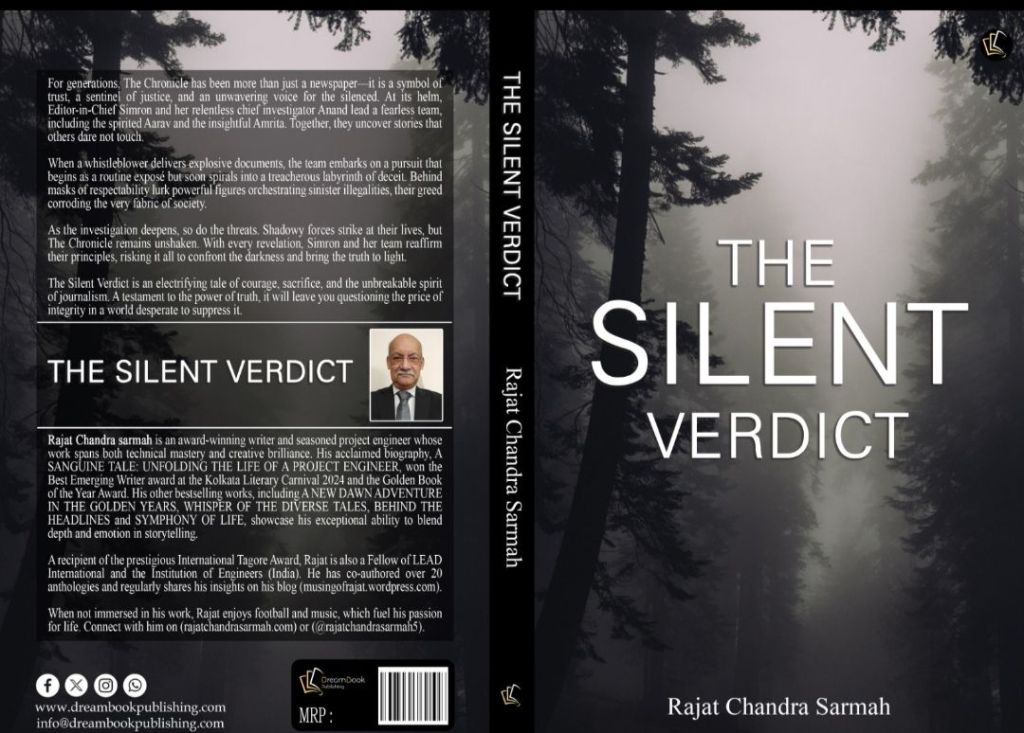
The Cover page of my new Thriller “The Silent Verdict”

The book is expected shortly .

PLEASE ENCOURAGE AND COMMENT

THE FIRESIDE FABLE.

A new anthology where I am a Co- Author is now published .

Shadows of the Banyan Tree” 

Part VI:  Secrets of the Estate

( c) All right reserved by the author

Instagram : @rajatchandrasarmah5

The following morning, Arun decided to visit the abandoned zamindar’s estate. The sprawling mansion, once a symbol of power and wealth, now stood in ruins. Vines crawled up its crumbling walls, and the air was thick with the scent of decay.

“Do you think we’ll find anything here?” Anjali asked as they stepped inside, their footsteps echoing in the empty hallways.

“If the zamindar was as cruel as they say, this place might hold answers,” Arun replied.

They began exploring the estate, their eyes scanning every corner for signs of Prakash and Meera. In the grand hall, they found faded portraits of the zamindar’s family, their stern faces frozen in time.

“I can’t imagine living in a place like this,” Anjali said, shivering despite the warm breeze filtering through the broken windows.

“It’s as if the walls themselves are haunted,” Arun said, his voice low.

Their search led them to the basement, a dark, musty space that reeked of neglect. As they navigated the labyrinth of rooms, Anjali stumbled upon an iron door partially concealed by debris.

“Arun! Over here!” she called out.

Arun hurried over, his heart pounding. Together, they cleared the debris, revealing the door in its entirety. It was heavy and rusted, but after some effort, they managed to pry it open.

Inside was a small, windowless room. The walls were lined with shelves, and on one of them sat a wooden box, its lid intricately carved. Arun opened it cautiously, revealing a collection of letters tied together with a red ribbon.

“These must be theirs,” Anjali said, her voice barely above a whisper.

Arun untied the ribbon and began reading. The letters were written by Prakash, addressed to Meera, but never sent. They spoke of his fears, his hopes, and his undying love for her.

“My dearest Meera,

Every moment apart from you feels like an eternity. The world may stand against us, but my love for you remains steadfast. If this is to be our end, let it be one filled with the knowledge that we dared to love in a world that feared it.”

Tears welled up in Anjali’s eyes as she read over Arun’s shoulder. “They knew what they were up against,” she said. “And yet, they chose love.”

As they sifted through the letters, Arun found one addressed not to Meera, but to the future.

“To whoever finds this,

If you’re reading these words, know that love is the greatest rebellion. It is the force that binds us, transcending time and space. Our story may end here, but let it inspire you to fight for what matters most. In love, there is freedom. In freedom, there is life.”

The words struck Arun like a bolt of lightning. He folded the letter carefully and placed it back in the box.

“They wanted their story to be told,” he said. “And we’re the ones to do it.”

As they left the estate, the sun was setting, casting a golden glow over the village. Arun felt a renewed sense of purpose. Prakash and Meera’s love had been buried for decades, but now, it would rise again, a testament to the power of the human spirit.

RAJAT CHANDRA SARMAH

GUWAHATI,ASSAM ,INDIA

14/01/2025

Shadows of the Banyan Tree” 

Part V: The Forgotten River

( c) All right reserved by the author

Instagram : @rajatchandrasarmah5

Arun and Anjali’s quest to unravel Prakash and Meera’s story brought them to the banks of the river Sameer had mentioned. The river, once a vital lifeline for the village, was now a shadow of its former self. Its waters, once pristine and abundant, had receded, leaving behind patches of dry, cracked earth.

“It must have been beautiful back then,” Anjali said, her gaze scanning the landscape.

Arun nodded. “And it was here their story came to an end—or so we’ve been told.”

Determined to explore the site further, they wandered along the riverbank, looking for any clues that might offer a glimpse into the past. As they walked, an old woman approached them, her frail frame supported by a wooden cane.

“You’re looking for something?” she asked, her voice quivering but sharp.

Arun and Anjali exchanged glances before Arun replied, “Yes, Dadi. We’re trying to learn about what happened to two people—Prakash and Meera—many years ago.”

The woman’s face softened. “Prakash and Meera… their love was the kind you hear about in stories. But the world wasn’t kind to them.”

“Did you know them?” Anjali asked.

“I was a child then,” the woman said. “But I remember the day they tried to cross the river. The zamindar’s men caught them. My father worked for the zamindar. He told me they were taken back to the estate. No one saw them after that.”

“Do you know what happened to them?” Arun asked, his voice steady despite the knot in his stomach.

The woman hesitated, her eyes clouded with memories. “Some say the zamindar locked them away, that they died in his dungeons. Others believe they were thrown into the river, their love and lives swept away by the current. But the truth? Only the river knows.”

Her words hung in the air, heavy with sorrow. Arun thanked her before she hobbled away, leaving them alone by the river.

“That’s it, then,” Anjali said, her voice tinged with frustration. “We’re back to speculation. No proof, no closure.”

Arun stared at the river, its waters shimmering under the afternoon sun. “Maybe we’re not meant to find closure,” he said. “Maybe the uncertainty is part of their story. It forces us to imagine, to remember, to keep their love alive in our hearts.”

As they left the river, Arun couldn’t shake the feeling that they were missing something—a key detail that tied everything together.

RAJAT CHANDRA SARMAH

GUWAHATI,ASSAM ,INDIA

13/01/2025

Micro Fiction (2)

(C) All rights reserved by the author

Instagram @rajatchandrasarmah5

4. He signed up for gym

packed his workout gear and took a few

photos

but after one session he never went back.

It takes more than that he Twitted sinking into

couch with a sigh, It needs time you know.


5. At family dinner everyone sat quietly

heads bent over phones.

Grandma leaned in and whispered to Grandpa

at least they’re quiet.

6. Politician promised

we’ll fix everything in 100 days

but 200 days later they were still blaming

everything on past.

Rajat Chandra Sarmah

Guwahati , Assam , India

12/01/2025

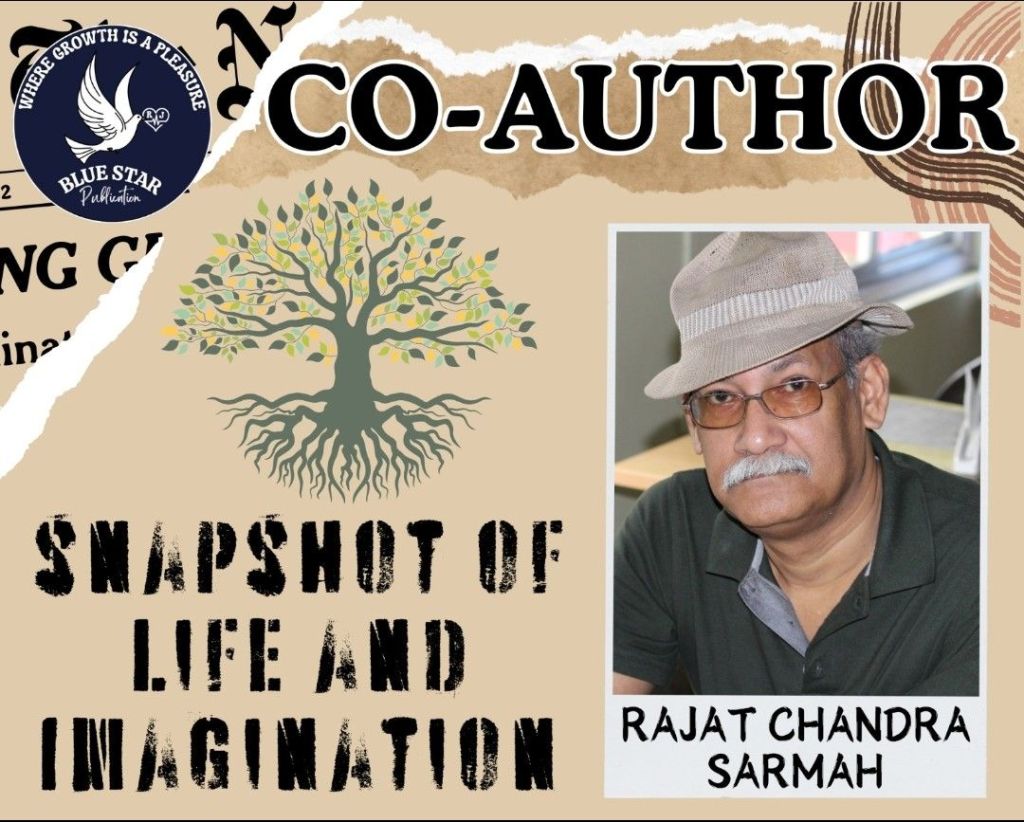
The anthology Snapshot of life and imagination is now published . Nice to be a part of it .

Title: “Laughing at the Irony: Tiny Tales of Modern Life”

(C)All rights reserved by the author

Instagram :@rajatchandrasarmah5

4. Fitness Goals

“He paid for a gym membership, posted photos of his protein shake, and quit after one session.

‘Results take time,’ he tweeted from the couch.”

5. The Smartphone Generation

“At the family dinner, everyone stared at their phones.

Grandma whispered, ‘At least they’re quiet.’”

6. Powerful Words

“The politician promised, ‘We’ll fix everything in 100 days!’

200 days later, they still blamed the last 100 years.”

Rajat Chandra Sarmah

Guwahati , Assam  India

11/01/2025

Shadows of the Banyan Tree” 

Part IV: Echoes in the Wind

( c) All right reserved by the author

Instagram : @rajatchandrasarmah5

Over the next few days, Arun and Anjali continued their quest to uncover the truth about Prakash and Meera. The village seemed alive with whispers of the past, each conversation adding a new layer to the story they were piecing together.

One afternoon, Anjali burst into Arun’s home, her face alight with excitement. “I found something!” she exclaimed, holding up a yellowed notebook.

“What is it?” Arun asked, his heart skipping a beat.

“It’s a journal,” Anjali said. “I came across it in the archives. It belonged to someone named Raghunath, who was a close friend of Prakash. He wrote about their meetings under the banyan tree and the challenges they faced.”

Arun’s hands trembled as he took the journal. The pages were fragile, the handwriting neat but hurried, as though the writer had been racing against time.

The entries painted a vivid picture of Prakash and Meera’s struggles. They spoke of secret meetings, coded messages, and plans for a future together. But they also revealed the growing threat posed by Meera’s father, who had vowed to put an end to their love.

“July 15, 1947,

Prakash is restless. Meera’s father has threatened to marry her off to a zamindar in another district. She’s terrified, but she refuses to back down. They’ve decided to elope, but the risks are enormous. I can see the weight of it all pressing down on Prakash. He’s torn between his love for Meera and his duty to the movement.”

“July 19, 1947,

The banyan tree is their sanctuary. They meet there every evening, hidden from prying eyes. It’s as though the tree shields them, its branches spreading wide like arms offering protection. But even the tree cannot keep them safe forever. Prakash has asked me to help them. I don’t know if I have the courage to defy Meera’s father, but how can I let them face this alone?”

The entries ended abruptly, leaving Arun and Anjali with more questions than answers.

“We have to find out what happened after that,” Arun said, his voice resolute.

Anjali nodded. “Maybe the elders know more. Or perhaps there’s someone who remembers Raghunath. He could have passed down the story to his family.”

Their search led them to Raghunath’s grandson, Sameer, who still lived in the village. He was a quiet man in his late sixties, his eyes filled with the wisdom of a life well-lived. When Arun and Anjali explained their purpose, Sameer nodded slowly.

“I remember my grandfather talking about Prakash and Meera,” he said. “He admired their courage, but their story haunted him till his last days. He always said they deserved better.”

“What happened to them?” Arun asked, leaning forward in anticipation.

Sameer sighed. “They tried to elope, but Meera’s father found out. His men caught them near the river, not far from here. No one knows exactly what happened, but they were never seen again. My grandfather believed they were… silenced.”

A heavy silence settled over the room. Arun felt a lump in his throat, the weight of the tragedy pressing down on him.

“Why didn’t anyone do anything?” Anjali asked, her voice trembling.

“It was a different time,” Sameer said. “The zamindar’s power was absolute. People were too afraid to stand up to him.”

As they walked back to the banyan tree, Arun couldn’t shake the image of Prakash and Meera, their dreams cut short by cruelty and greed.

“They were fighting for freedom, not just for the country, but for themselves,” he said. “And yet, they were denied even that.”

Anjali placed a hand on his arm. “But their love endured, Arun. It lives on in these letters, in the stories people tell, and in this tree. Maybe that’s their legacy.”

That evening, Arun sat under the banyan tree once again, his thoughts heavy with the weight of the past. He looked up at the branches, their leaves shimmering in the fading light.

“Prakash. Meera,” he whispered. “I promise I’ll tell your story. The world will know who you were and what you stood for.”

As the wind rustled through the leaves, Arun felt a strange sense of peace, as though the tree itself was offering him its blessing.

RAJAT CHANDRA SARMAH

GUWAHATI,ASSAM ,INDIA

09/01/2025

Shadows of the Banyan Tree” 

Part III: Whispers of the Village:

( c) All right reserved by the author

Instagram : @rajatchandrasarmah5

The next day, Arun and Anjali set out to uncover the story of Prakash and Meera. Their first stop was the tea stall near the banyan tree, a place where the village’s elders gathered every morning. The aroma of freshly brewed chai mingled with the earthy scent of dew-soaked soil, and the hum of conversations filled the air.

As they approached, Arun spotted Gopal Kaka, who had been among the first to greet him upon his return. He was seated on a wooden bench, surrounded by three other men of his age, each clutching a clay cup of tea.

“Arun! Anjali!” Gopal Kaka called out, waving them over. “What brings you two here so early?”

Arun sat beside him, placing the tin box on the table. “Kaka, I need your help. Do you recognize these names?”

He handed Gopal one of the letters signed by Prakash. The old man adjusted his spectacles and squinted at the faded script. His expression shifted from curiosity to surprise.

“Prakash and Meera…” he murmured, trailing off.

The other elders leaned in, their interest piqued. One of them, a retired schoolteacher named Hariram, spoke up. “Prakash and Meera? That takes me back nearly sixty years. They were the talk of the village in those days.”

“What do you remember about them?” Anjali asked, her notebook ready to capture every detail.

“Prakash was a schoolteacher, much like me,” Hariram began. “But he had a fire in him—a passion for change. This was during the 1940s, when the independence movement was at its peak. Prakash was deeply involved, organizing rallies and educating the villagers about their rights.”

“And Meera?” Arun prompted.

“Ah, Meera,” Gopal Kaka said with a wistful smile. “She was the daughter of a wealthy zamindar. Beautiful, sharp-witted, and fiercely independent. She was unlike any other girl in the village. When she and Prakash fell in love, it caused quite a stir.”

“Why?” Anjali asked.

Hariram sighed. “For one, their families were poles apart. Prakash came from a modest background, while Meera’s family was influential and deeply rooted in tradition. Her father was vehemently opposed to the match.”

“They used to meet secretly under the banyan tree,” Gopal Kaka added. “Everyone in the village knew about it, but no one dared to say anything to Meera’s father.”

“What happened to them?” Arun asked, his voice tinged with urgency.

The elders exchanged glances, their expressions somber. “No one knows for sure,” Hariram said. “One day, they just disappeared. Some say they ran away together. Others believe something more sinister happened. The zamindar was a ruthless man. If he found out…”

His voice trailed off, leaving the sentence unfinished.

Arun’s heart sank. The letters and photographs had given him a glimpse of a love so pure, so resilient. The idea that it might have ended in tragedy was unbearable.

“Do you think they’re still alive?” Anjali asked, breaking the silence.

“Unlikely,” Gopal Kaka said. “But their story lives on in whispers. The banyan tree… it feels like a guardian of their memory. As if it’s holding on to their love, refusing to let it fade.”

The conversation left Arun and Anjali with more questions than answers. They decided to visit the village archives next, hoping to find records that might shed light on Prakash and Meera’s fate.

The archives were housed in an old building near the village temple. The caretaker, a wiry man named Rajesh, greeted them with a skeptical look. “You’re looking for records from sixty years ago?” he asked, raising an eyebrow.

“Yes,” Anjali said. “Anything related to Prakash or Meera.”

Rajesh sighed but led them to a dusty corner filled with bound volumes and loose papers. “Good luck,” he said. “You’ll need it.”

Hours passed as they sifted through the records, the room filled with the sound of rustling paper. Finally, Arun stumbled upon a document that caught his attention—a list of participants in a protest organized in 1947.

“Prakash’s name is here,” he said, showing it to Anjali.

“And look,” Anjali said, pointing to another name on the list. “Meera.”

The discovery sent a jolt of excitement through them. It confirmed that Meera had been more than just a bystander in Prakash’s life; she had been his partner in both love and revolution.

But their triumph was short-lived. As they continued their search, they found no further mention of the couple. It was as though they had vanished into thin air.

As they left the archives, the sun was setting, casting a golden glow over the village. Arun looked toward the banyan tree, its silhouette stark against the fiery sky.

“They trusted this tree with their love,” he said quietly. “If it could talk, it would tell us everything.”

Anjali placed a hand on his shoulder. “Maybe it already is, Arun. We just have to listen.”

That night, Arun sat beneath the banyan tree, his thoughts racing. The elders’ stories, the archived records, the letters—they were all pieces of a puzzle he was determined to solve. He ran his fingers over the tree’s gnarled roots, as if seeking answers in their twists and turns.

The wind whispered through the leaves, carrying with it a faint, haunting melody. Arun closed his eyes, letting the sound envelop him. For a brief moment, he felt as though he wasn’t alone, as though Prakash and Meera were there with him, their love as enduring as the tree that had borne witness to it.

RAJAT CHANDRA SARMAH

GUWAHATI,ASSAM ,INDIA

08/01/2025