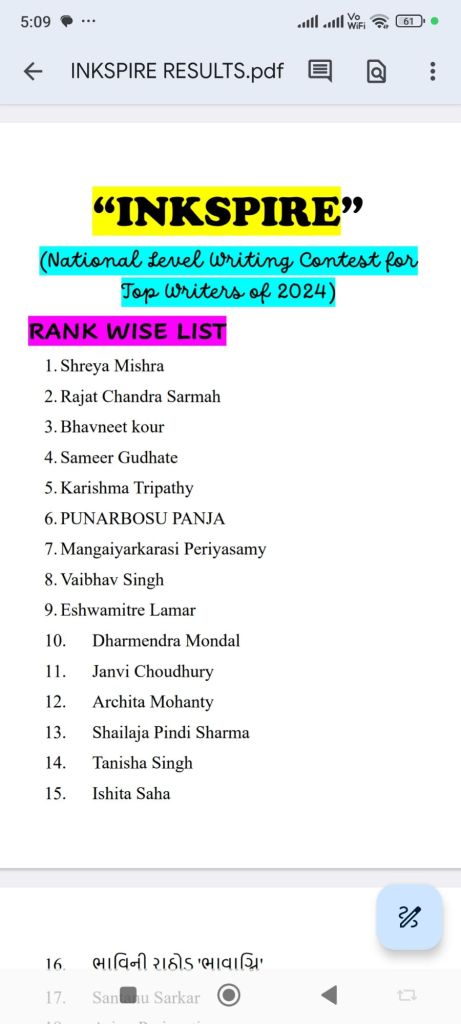
NATIONAL LEVEL WRITING COMPETITION – INKSPIRE

Shadows of the Banyan Tree” 

Part II: The Letters of the Past

( c) All right reserved by the author

Instagram : @rajatchandrasarmah5

Continued from part -I

The next morning, Arun sat by his window, the tin box on the table before him. The soft morning light spilled over the faded letters and photographs he had uncovered the previous night. Each item seemed to hum with the weight of untold stories. He sipped his tea, a mixture of curiosity and hesitation brewing within him.

Finally, he picked up the first letter, unfolding the fragile paper with care. The ink had faded but was still legible, each word a portal to a time long gone.

“Dearest Meera,

Today, as I stood under our banyan tree, I thought of the promises we made. This tree, with its roots so deep, reminds me of us—grounded, yet yearning to reach the skies. I hope you are well. I hope you still believe in us.”

The letter was signed simply: Prakash.

Arun leaned back in his chair, the letter trembling slightly in his hand. He reached for another and began reading:

“Meera,

The world is changing faster than I can comprehend. They’ve asked me to lead a group to organize protests in the neighboring district. But my heart hesitates, torn between duty and the life I want to build with you. Sometimes, I wish we could leave all this behind and start anew somewhere far away. Underneath our banyan tree, I feel safe. I feel yours.”

The letters painted a vivid picture of a man caught between love and revolution. Arun felt an ache in his chest, as though he’d stumbled upon a reflection of his own struggles.

He spread the photographs out on the table, studying each one carefully. In one, a young woman sat on a low branch of the banyan tree, her face tilted toward the sunlight. Her saree billowed in the wind, and her laughter seemed almost audible. Beside her stood a man, his hand resting protectively on the branch, his eyes focused on her. Arun felt as though he’d intruded on a private moment, yet he couldn’t look away.

“Who were you, Prakash and Meera?” he murmured. “And why were your stories buried here?”

That afternoon, he decided to share his discovery with Anjali. She was the only person in the village who could match his inquisitiveness. Anjali had been his closest friend growing up, and though life had taken them on different paths, their bond had remained intact.

When Arun arrived at her home, Anjali was sitting on her porch, typing furiously on her laptop. She looked up and grinned. “Arun! To what do I owe this unexpected visit?”

“I need your help,” Arun said, holding up the tin box.

Anjali’s eyes lit up with curiosity. “What’s this?”

“Something I found near the banyan tree,” Arun replied, setting the box down on the table. “Letters. Photos. A story, I think.”

Anjali untied the ribbon and began leafing through the letters. Her expression shifted from intrigue to awe as she read. “This is incredible, Arun,” she said softly. “These letters are like a window into another era.”

“They’re haunting me,” Arun admitted. “I feel like I have to know who they were.”

Anjali leaned back, tapping a finger against her chin. “You know, this could be bigger than just a personal curiosity. Imagine writing about this—turning it into a feature story. It could even help save the banyan tree if we can tie it to the village’s heritage.”

Arun hesitated. “But we don’t know the whole story. What if we’re missing something crucial?”

Anjali smiled. “That’s the beauty of stories like this, Arun. The gaps are where the magic happens. We don’t just tell what we know; we imagine what could have been.”

They decided to start by gathering information. Arun suggested speaking to the village elders, who might remember something about Prakash and Meera. Meanwhile, Anjali promised to research historical records to see if the couple’s names appeared anywhere.

Before leaving, Anjali handed Arun a letter. “This one’s my favorite,” she said. “It’s heartbreakingly beautiful.”

That evening, Arun sat under the banyan tree, reading the letter Anjali had chosen.

“My dearest Meera,

As I sit beneath our banyan tree, I can’t help but wonder if the roots beneath me feel the same pull as I do. A yearning to stay grounded, yet an ache to reach farther than ever before. I don’t know when I’ll see you again, but I promise this tree will always be my witness. And if you ever doubt me, come here. Close your eyes. You’ll feel my presence in its shadow.”

Tears pricked Arun’s eyes. He folded the letter and placed it back in the box, his resolve strengthening. He would uncover their story—not just for himself, but for the banyan tree that seemed to carry their legacy in its roots.( To be continued)

RAJAT CHANDRA SARMAH

GUWAHATI,ASSAM ,INDIA

06/01/2025

“The Lighter Side of Society: Tales to Tickle and Think”

( c) All right reserved with the author.

Instagram : @rajatchandrasarmah5

MY new journey with Microfiction. Hope my readers will enjoy it .

1. The Great Queue


“Everyone stood in line for the grand sale. The man in the front asked, ‘What’s on discount?’
The cashier grinned, ‘Patience’

2. Work-from-Home Reality


“Her boss scheduled a 7 a.m. video call. She wore a blazer, pajama shorts, and muted her kids’ squabbles.
Great presentation he said, while his cat walked across the screen.”

3. The VIP Culture


“The VIP car honked furiously through the traffic jam it caused.
A vendor muttered, ‘Their urgency is contagious. Too bad their solutions aren’t.’”

RAJAT CHANDRA SARMAH

GUWAHATI , ASSAM , INDIA

05/01/2025

Shadows of the Banyan Tree

Part1: The Ancient Guardian

( c) All right reserved by the author

Instagram : @rajatchandrasarmah5

The village of Barakpur was a place where time moved slower, where the echoes of the past lingered in every corner. At its heart stood the banyan tree—a majestic, ancient giant that had witnessed the passing of generations. Its roots sprawled across the square like veins, breaking through the cobblestones and carving their own path. The canopy was so wide it cast a shadow over the bustling marketplace, shielding vendors and buyers from the sun’s relentless glare.

Locals called it Kalpataru, the wish-fulfilling tree, a name passed down through folklore. Children grew up believing that tying a red thread to its branches would make their dreams come true. For the elders, it was a symbol of resilience and permanence, a reminder of a time when life was simpler.

When Arun stepped off the rickety bus that had brought him back to Barakpur, the first thing he noticed was the banyan tree. He stood still, his suitcase dangling loosely from his hand. A gust of wind rustled the leaves, and Arun felt as though the tree were greeting him, a silent acknowledgment of his return.

He hadn’t been back in over a decade. The city had swallowed him whole, its cacophony drowning the whispers of his childhood. But life in the city had become unbearable—a dead-end job, a failed relationship, and a gnawing emptiness that no amount of urban convenience could fill. Arun had come back to find himself, or at least to figure out what he’d lost along the way.

“Arun, is that you?”

A voice broke his reverie. Turning, he saw Gopal, his childhood neighbor, now an elderly man with a walking stick. His face was wrinkled, but his eyes still sparkled with the mischief of youth.

“Yes, Gopal Kaka. I’m back,” Arun said, offering a hesitant smile.

“Back for good?” Gopal asked, his tone tinged with curiosity.

“For now,” Arun replied. “The city… it’s not for me anymore.”

Gopal nodded knowingly. “The city changes people. But Barakpur has a way of reminding you who you are.”

The two men walked together toward the banyan tree. Arun noticed changes in the village—new buildings, tarred roads, and a faint buzz of modernization. But the banyan tree stood as it always had, its roots and branches unfazed by time.

Beneath the tree’s shade, life thrived. Vendors sold vegetables, spices, and trinkets. Children chased each other around the roots, their laughter blending with the chatter of shoppers. Arun’s heart ached with nostalgia. He remembered sitting under this tree as a boy, reading books or listening to the elders spin tales of freedom fighters and lost lovers.

But something was different now. The tree, once the centerpiece of the village’s soul, was surrounded by political banners and posters. Slogans of various parties were painted crudely on its trunk, and the air carried whispers of its impending doom. Arun overheard a vendor complaining about a municipality plan to cut down the tree to widen the road.

“The tree’s roots are damaging the square,” said one man.

“And the traffic here is terrible,” another chimed in. “We need that road.”

Arun felt a pang of unease. Cutting down the banyan tree? It seemed unthinkable. Yet, in a world driven by progress, even the most sacred symbols weren’t safe.

That evening, Arun sat on a wooden bench near the tree, watching the sunset. The orange hues painted the sky, and the tree’s shadow stretched long across the square. For a moment, he felt a strange connection, as though the tree were alive, breathing, and trying to speak to him.

“Welcome back,” it seemed to whisper.

Just as Arun was lost in thought, a stray dog trotted up to him, wagging its tail. Arun chuckled and reached down to pet it. “You’re the first one to officially welcome me home,” he said.

As the stars began to dot the night sky, Arun decided to walk around the tree one last time before heading home. That’s when he noticed something unusual—a small patch of disturbed earth near one of the roots. Intrigued, he knelt down and began digging with his hands.

Buried beneath the soil was an old tin box, rusted and battered by time. Arun’s heart raced as he pried it open. Inside were faded letters tied with a red ribbon, along with a stack of sepia-toned photographs.

The letters were addressed to someone named Meera, signed by a man named Prakash. Arun skimmed through the first few lines, his curiosity piqued by the poetic language and heartfelt confessions. The photographs showed a young couple standing near the banyan tree, their smiles radiant and full of promise.

Who were Prakash and Meera? And why had their memories been buried here, hidden from the world?

Arun slipped the letters and photographs back into the box, his mind swirling with questions. The banyan tree, it seemed, held secrets far deeper than its roots. And for the first time in years, Arun felt a spark of purpose.

RAJAT CHANDRA SARMAH

GUWAHATI,ASSAM ,INDIA

04/01/2025

The Stranger on the Train”

( c) All right reserved by the author 

Instagram : @rajatchandrasarmah5

It was a sweltering afternoon in June, and the train station was buzzing with the usual cacophony of travelers, announcements, and the clatter of luggage wheels. I was on my way to Guwahati from Delhi, a journey I had made many times before, but this time, I would carry back an experience I could never forget.

The train was packed to the brim, as it often is in India, and I had secured a lower berth in the sleeper class—a rare luxury. As the train heaved out of the station, I settled into my corner with a book, hoping for an uneventful journey.

But life has a way of surprising you when you least expect it.

About an hour into the journey, at a small, dusty station, a man boarded the train and occupied the berth opposite mine. He appeared to be in his late forties, with a weathered face that hinted at a life of toil. His clothes were simple, his bag tattered, but there was an air of dignity about him that caught my attention.

As the train rocked gently along the tracks, we struck up a conversation. He introduced himself as Ramesh, a farmer from a remote village in Bihar. He was traveling to Delhi to meet his son, who had recently secured a job there. His pride in his son was palpable, and he spoke with a mixture of joy and apprehension about the changes in their lives.

I listened intently, sharing snippets of my life in return. He seemed genuinely interested, nodding and smiling at the right moments. There was something comforting about his presence—an authenticity that is rare in a world often driven by superficial connections.

As the evening wore on, Ramesh pulled out a small cloth bundle from his bag. Inside were homemade rotis and a simple potato curry. He offered me a share, insisting with a warmth that left no room for refusal. I hesitated at first, but his generosity was contagious, and I soon found myself enjoying the meal. It tasted of care and simplicity, a stark contrast to the rushed, pre-packaged food I had brought along.

In return, I shared some biscuits and chocolates I had packed for the journey. His childlike delight at the chocolates made me smile, and for a moment, we were just two humans sharing a meal, our differences fading into insignificance.

As night fell, the conversation took a more serious turn. Ramesh spoke of the struggles of farming—how unpredictable weather, mounting debts, and the lure of city life were driving people away from the land. He spoke with a quiet resignation, but there was also a glimmer of hope in his words, a belief that things could change.

His story resonated with me in ways I hadn’t anticipated. I had always considered myself empathetic, but hearing his struggles firsthand gave me a new perspective. It made me realize how disconnected I had become from the realities of rural life, despite having grown up in a small town myself.

As the train chugged through the night, Ramesh fell asleep, his face relaxed in the dim light. I sat by the window, staring at the dark expanse outside, lost in thought. Meeting him had stirred something within me—a sense of gratitude, a desire to reconnect with the simpler things in life, and a newfound respect for the resilience of people like him.

The next morning, as the train neared Delhi, Ramesh prepared to disembark. He shook my hand firmly, thanking me for the conversation and the shared meal. “You’ve made this journey memorable,” he said with a smile.

I watched him walk away, blending into the crowd at the station. The train pulled out, and I found myself staring at the empty berth opposite mine, feeling an odd mix of sadness and contentment.

Life moved on, as it always does, but the memory of that journey stayed with me. It reminded me of the power of human connection, the beauty of shared stories, and the importance of seeing beyond the surface.

Even now, years later, I find myself thinking of Ramesh whenever I travel by train. His story, his warmth, and his quiet dignity continue to inspire me, a reminder that sometimes, the most profound lessons come from the most unexpected encounters.

Rajat Chandra Sarmah 

Guwahati ,Assam , India

03/01/2025

“Whispers of the New Year”

(C) All right reserved by the author

Instagram @rajatchandrasarmah5

A quiet night turns into dawn’s embrace,
The clock strikes twelve, a fleeting space.
A year departs, its echoes fade,
A new path calls, yet unwade.

Stars shimmer with promises untold,
Dreams awaken from slumber’s hold.
Hope whispers softly through the breeze,
“Begin again, with hearts at ease.”

The world wears a cloak of fleeting snow,
Covering wounds, letting kindness grow.
Every crack in time, a lesson’s trace,
Each failure—a chance to find your grace.

Fireworks bloom, the sky ignites,
Banishing shadows of the nights.
Laughter rises, and spirits mend,
A chorus of joy, where fears suspend.

Yet beneath the cheer lies a silent plea,
For love, for peace, for unity.
The earth spins on, both frail and strong,
Carrying stories, righting wrongs.

So step forward, with courage anew,
Let kindness be the thread you sew.
For this year may be fleeting, like all before,
But its whispers can open another door.

RAJAT CHANDRA SARMAH

Guwahati , Assam , India

02/01/2025

National Author Competition

“Be Limitless” by Blue cloud publishers results were out today . Proud to see my name amongst the winners.

NEW YEARS GIFT

The New Year Chronicles: 

Resolutions, Ruckus, and Reality

© All rights reserved by the author

Instagram: @rajatchandrasarmah5

In a small Indian town nestled along the banks of the Ganga, the anticipation of a new year was as thick as the winter fog. Loudspeakers blared the latest Bollywood remixes, and street vendors hawked cheap glittery “2024” hats and plastic horns. Every corner shop displayed banners proclaiming “New Year, New Beginnings!” as though the digits themselves held the promise of salvation. Amidst this controlled chaos was Ramesh, the town’s chaiwala and unchallenged philosopher-in-residence, preparing for what he called his “Annual New Year Symposium.”

The Build-Up

Ramesh’s chai stall was no ordinary tea joint. It was the epicenter of heated debates, unsolicited advice, and the occasional existential crisis. On December 30th, the regulars gathered as usual, sipping chai and discussing their grand New Year plans.

“Arre, this year I’m quitting cigarettes for good,” Banwari announced, taking a deep drag from his cigarette as he spoke.

Kamla, the neighborhood gossip, wasn’t far behind. “I’ve decided to join yoga classes,” she declared, conveniently forgetting her distaste for early mornings.

Even Golu, a pudgy 12-year-old with a samosa in each hand, added his two bits. “I’ll stop eating junk food… after New Year’s Eve, of course.”

Ramesh, pouring chai with the precision of a scientist, smirked. “So, everyone’s making promises, eh? Let me guess—by February, Banwari will still be puffing away, Kamla will be snoozing through her yoga classes, and Golu will still be found at the chaat stall.”

The group burst into laughter, though Banwari’s chuckle had a nervous edge.

“Listen,” Ramesh continued, his tone playful yet sharp, “resolutions are like Bollywood sequels—big hype, no substance. Everyone loves the idea of change, but few actually work on it. And when they fail, they blame the calendar, not themselves.”

A The Countdown

December 31st arrived, and the town square transformed into a carnival. Kite sellers, fairy lights, and an open stage added to the festive air. The loudspeakers switched to remixed bhajans after a stern warning from the local pandit, who felt Bollywood was tarnishing the sanctity of the occasion.

On the stage, Sunil, the local poet and part-time teacher, performed his yearly ode to New Year resolutions:

“This year I swear, I’ll be more wise,

But soon, like kites, my promises fly!”

The audience clapped and laughed, some already discreetly sipping desi daaru from pocket flasks. Meanwhile, Ramesh stood at his chai stall, watching the spectacle unfold.

A group of college students, emboldened by caffeine and curiosity, approached him. “Ramesh bhaiya, why do you always mock New Year resolutions? Shouldn’t we at least try to improve ourselves?”

Ramesh set down his kettle, theatrically wiped his hands, and said, “Beta, resolutions aren’t bad. But tell me, why wait for January 1st to quit smoking or start yoga? Improvement doesn’t need a calendar; it needs commitment. If you need fireworks and a countdown to inspire change, you’re not serious about it.”

The students nodded thoughtfully, though one muttered under his breath, “He sounds like my father.”

 The Absurdities

As midnight approached, the town erupted in excitement. Firecrackers lit up the sky, and phones buzzed with WhatsApp forwards filled with motivational quotes and recycled jokes. Golu, armed with a plastic horn, ran around scaring stray dogs, much to their dismay.

Kamla was caught red-handed at the dessert counter, stuffing her mouth with gulab jamuns. “It’s the last day of the year!” she protested when confronted. “Yoga can wait till tomorrow!”

Banwari, who had sworn off cigarettes earlier in the day, was seen lighting one at exactly 12:01 AM. “This is just symbolic,” he rationalized.

Even Sunil, the poet, was overheard composing a new verse between bites of aloo chaat:

“This year I’ll diet, I truly insist,

But first, let me enjoy one last twist!”

Ramesh, observing these antics from his stall, couldn’t help but chuckle. “Humans are hilarious,” he muttered to himself. “We crave change, but cling to our habits like a dog to its bone.”

 The Aftermath

By mid-January, the festive fervor had faded, and life in the town returned to its usual rhythm. Kamla’s yoga mat had become a makeshift rug for her cat. Banwari was back to his pack-a-day habit, and Golu was spotted devouring pani puris with unabashed glee.

At the chai stall, the regulars sheepishly admitted their failures. “You were right, Ramesh bhaiya,” Kamla sighed. “New Year promises are useless.”

Ramesh shook his head. “Not useless, Kamla. Just misunderstood. You all make grand, sweeping resolutions. Start small, my friends. Real change is like good chai—it takes time to brew. Focus on one habit at a time, and celebrate small wins.”

 The Wisdom

That evening, Ramesh shared his closing thoughts on the New Year. “Look, the problem isn’t making resolutions; it’s turning them into a circus. Improvement doesn’t need fireworks or Instagram posts. It needs patience, discipline, and a willingness to forgive yourself when you slip.”

He raised a cup of chai and declared, “Here’s to doing better, one small step at a time. Drink good chai, laugh often, and never stop trying—even if it’s March, April, or November.”

The crowd at the stall cheered, their spirits lifted not by resolutions, but by the wisdom of a chaiwala who had mastered the art of living.

As the sun set over the Ganga, the town welcomed the New Year not with unrealistic promises, but with humility, laughter, and, of course, a steaming cup of chai.

Rajat Chandra Sarmah

Guwahati, Assam , India 

31/12/2024

WISH ALL MY READER A VERY VERY HAPPY , PRODUCTIVE AND ENJOYABLE NEW YEAR 2025

Please read my article published today

https://reflections.live/articles/17920/the-eternal-quest-of-happiness-is-it-an-illusion-article-by-rajat-chandrasarmah-19664-m5b256y7.html

The Silent Symphony of Solitude( Part -V)

© All rights reserved by the author

Instagram: @rajatchandrasarmah5

 The Path of Uncertainty

The following months were a blur of activity. Arun packed his belongings, bid farewell to his father, and took a leap of faith. He moved to New Delhi, where he quickly found himself immersed in the world of academia. His work was well-received, and he was soon recognized as a promising scholar in his field. His papers were published, and his research garnered attention from scholars across the globe.

But despite the accolades and the prestige, Arun never felt truly at home in the city. His heart still ached for Kaliya, for the simple life he had left behind. He longed for the peaceful evenings spent under the oak tree, for the familiar faces of his students, for the sense of purpose that came from teaching the children of his village.

Arun continued to commute between New Delhi and Kaliya, but the strain of balancing two worlds began to take its toll. The demands of academia were relentless, and the time he spent in Kaliya became shorter and shorter. He found himself increasingly disconnected from the life he had known, from the people who had shaped him.

The loneliness of the city was something Arun had not anticipated. Despite the bustling streets and the crowded halls of the university, he felt more isolated than ever before. The city, with all its energy and excitement, seemed to amplify his sense of disconnection. He missed the quiet of Kaliya, the sense of community, the simplicity of life. He missed the oak tree, which had been his anchor for so long.

One night, after a particularly exhausting day, Arun found himself wandering the streets of New Delhi, lost in thought. He walked for hours, trying to clear his mind, but nothing seemed to help. His thoughts were a tangle of frustration, guilt, and confusion. He had made so many sacrifices to get here, but at what cost? Was this the life he had always dreamed of, or had he simply traded one form of loneliness for another?

As he walked, Arun stumbled upon a small temple tucked away in a quiet corner of the city. It was a simple structure, with peeling walls and a small idol of Lord Vishnu. Arun entered the temple, finding solace in its stillness. He sat down in front of the idol, closing his eyes and offering a silent prayer. He asked for guidance, for clarity, for peace.

In that moment of silence, Arun felt a wave of understanding wash over him. He realized that his journey was not about choosing between two paths. It was about creating his own path, one that could accommodate both his dreams and his responsibilities. He didn’t need to choose between Kaliya and New Delhi — he could carve out a life that allowed him to live fully in both worlds. The city was not his enemy, nor was his village. Both held pieces of his soul, and he could embrace them both without guilt.

With renewed clarity, Arun returned to Kaliya, where he resumed his work at the school with a new sense of purpose. He continued his academic pursuits, but he also remained committed to the people and the land that had shaped him. Arun had found his peace — not in the pursuit of fame or success, but in the quiet balance between the two worlds he had come to call home.

And as the years passed, Arun continued to teach, to write, and to live with the knowledge that the greatest success was not in achieving the world’s recognition, but in finding harmony within oneself. The oak tree, ever steadfast, stood as a silent witness to his journey — a symbol of the strength, the sacrifices, and the quiet symphony of life that continued to unfold in the hills of Kaliya.(END)

Rajat Chandra Sarmah 

Guwahati , Assam , India 

29/12/2024